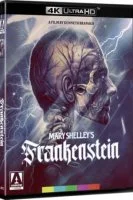
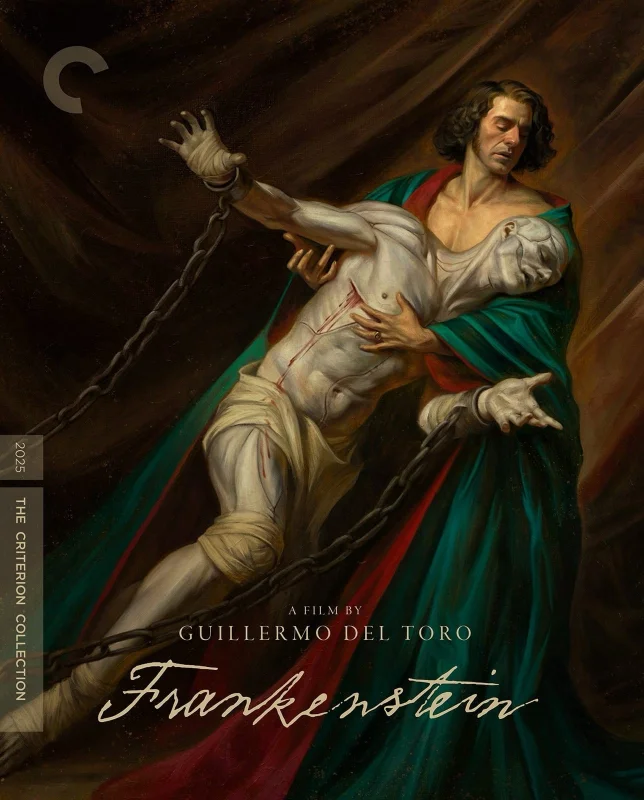
Frankenstein 4K 2025 Ultra HD 2160p
 Like
 Don't Like
From the very first frame, the inhospitable snow-covered expanses take your breath away: immense chunks of ice loom over the sailors, wrapped in tattered coats. The ship is trapped in the northern waters: the hardest part about these wild lands isn’t even getting off the icy shoal, but picking up a random passenger. But Captain Anderson (Lars Mikkelsen) is destined to witness the encounter between a shaggy-haired man with a cold heart (Oscar Isaac) and a frenzied monster (Jacob Elordi)—one with his soul laid bare and the other with clenched fists.
The prologue is followed by two chapters—creation and farewell: in the first, Victor Frankenstein, a scientist obsessed with defeating death, experiments with eugenics and electricity. In the next, the Miracle, born of these experiments, wants to learn to live and even to love, but its timid feelings toward the world around it are doomed to go unreciprocated because of the creature’s physical deformity—it was stitched together from other bodies.
User Review
This is already the second film by del Toro (after *Nightmare Alley*) that brings the same memory to mind.
My mom had a musical jewelry box. When I was a kid, I’d open it, and a little plastic ballerina would pop up and start playing a beautiful, slightly sad melody. Overall, I enjoyed it every time, but by the end, I kept catching myself thinking that this melody had never once surprised me. Just like “Frankenstein,” actually.
I’ll give it its due—the film looks magnificent. Baroque mansions, heavy costumes bathed in the golden twilight of candlelight, a snow-covered frigate in the middle of an icy desert. It’s as if the finest craftsmen of the Victorian era decided to build a fairy tale and Netflix gave them an unlimited budget. Seriously. There are plenty of scenes in the film that I could frame, so for the first forty minutes or so, I happily admired the makeup, the dresses, and the stucco moldings, all the while waiting to see where the story would take me next.
And then it turned out that there were no more surprises in store.
Just like in the novel, the story is told by two unreliable narrators. Half the time, Victor Frankenstein speaks; the other half, his creation. Each explains what happened in their own way, and each—as is often the case—rewrites the past a little.
You probably know the plot of the novel, even if you’ve never opened the book. A young scientist tries to conquer death after a devastating loss, and in a tall tower, he creates life from dead matter, bringing a monster into the world. However, gradually he and everyone around him come to realize that the most terrifying creature in this story might not have been created by a bolt of lightning after all.
It’s funny that the movie doesn’t even make this metaphor into a question. At one point, the protagonist’s loved ones literally shove the idea in his face: “You’re the real monster here, Victor.” But by that scene, I had fully come to terms with the fact that I was watching a fairy tale—a very beautiful one, but a fairy tale nonetheless.
In a fairy tale, a monster can move a ship but can’t break the shackles on his hands (he needs to work out). In a fairy tale, a curly-haired hero falls in love at first sight with a woman who looks suspiciously like his mother. In a fairy tale, a man spends years pursuing a vengeful goal, only to have his heart completely transformed in a couple of hours of revelations.
What really struck me about Mary Shelley’s work was the theme of tragic responsibility. Not even the fact of creating the monster itself, but the fact that some mistakes cannot be undone by either repentance or understanding. As we know, sometimes understanding is the punishment itself. Del Toro seems to soften this message and almost offers comfort—you can do terrible things, then come to understand everything, forgive, and be forgiven. It sounds very beautiful, but real life around us is less forgiving of our decisions.
And even the little details contribute to this feeling. Victor drinks milk as if it held the secret to immortality. The monster blows himself up with a stick of dynamite, but miraculously, even his clothes remain intact. There aren’t many moments like these, but each time they broke the magic of the film for me and reminded me that what I was watching was a legend that was a bit too neat.
If I’d seen this movie at ten o’clock at night on STS when I was a kid, it might have left a different impression. Back then, I loved costumed fairy tales (Soviet ones, to be sure) and wanted to believe that people would inevitably realize their mistakes.
With age and experience as a psychologist, I’ve learned that sometimes the monster turns out to be someone other than the one who was created. Sometimes responsibility outlives love, and we only understand everything after the disaster, when there’s no one left to ask for forgiveness.
That’s probably why, for the entire two hours, I watched this magnificent monster with respect but without much enthusiasm. It looks beautiful. But personally, I wish it would bite.
Info Video
Codec: HEVC / H.265 (74.3 Mb/s)
Resolution: Native 4K (2160p)
HDR: Dolby Vision, HDR10
Aspect ratio: 1.85:1
Original aspect ratio: 1.85:1
Info Audio
#English: Dolby TrueHD with Dolby Atmos 7.1 (48kHz, 24-bit)
#English: Dolby Digital 5.1
The Reborn Cut:
#English: Dolby TrueHD with Dolby Atmos 7.1
#English: Dolby Digital 5.1
#English: Dolby Digital 2.0 (Commentary by director/writer Guillermo del Toro)
Info Subtitles
English SDH (PGS), Arabic, Basque, Catalan, Chinese (Simplified), Chinese (Traditional), Croatian, Czech, Danish, Dutch, Filipino, Finnish, French (Metropolitan), Galician, German, Greek, Hebrew, Hungarian, Indonesian, Italian, Japanese, Korean, Malay, Norwegian, Polish, Portuguese (Brazilian), Portuguese (European), Romanian, Russian, Spanish (Castilian), Spanish (Latin American), Swedish, Thai, Turkish, Ukrainian, Vietnamese.File size: 83.18 / 83.65 GB