












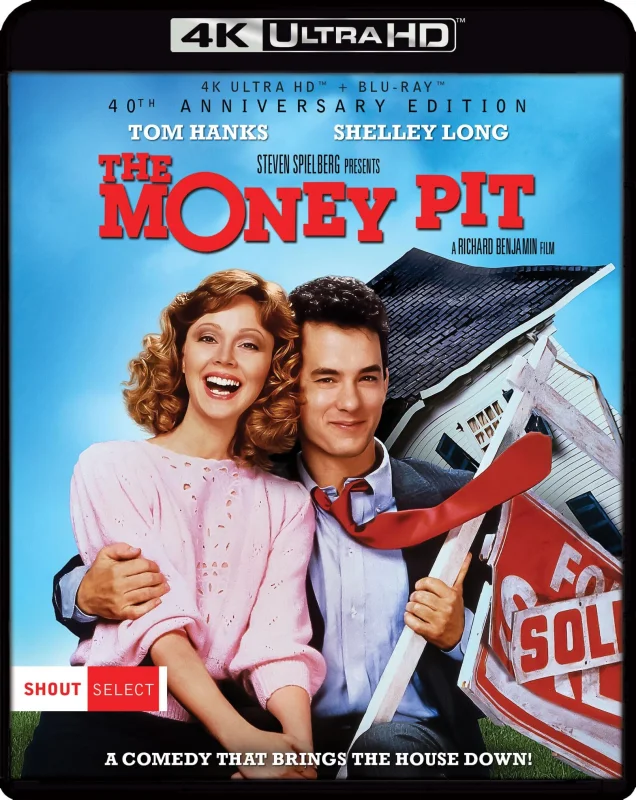
The Money Pit 4K 1986 Ultra HD 2160p
 Like
Like Don't Like
After Walter and Anna were forced to move out of their apartment in downtown New York, they decided to buy their own house! But where would they get that kind of money? Just then, as luck would have it, an acquaintance offered them what seemed to be a wonderful house at a wonderful price—the kind of offer you usually can’t turn down.
And our unsuspecting heroes decided to go for it. If only they’d known what kind of house they were getting! A house “with a surprise” awaited them—a home that was falling apart right before their eyes, where absolutely nothing worked! But the undaunted Walter decides to tackle the renovation of their new purchase. A battle with the dilapidated mansion begins—a battle not for life, but for death!
User Review
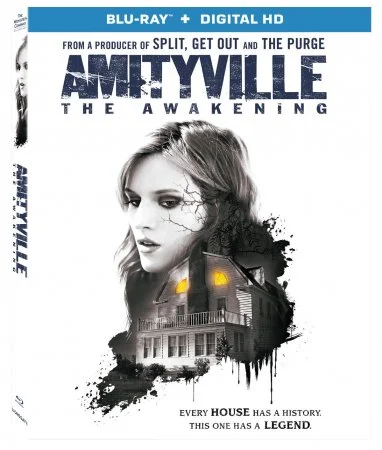
Even the residents of the house in Amityville were luckier. Although they bought a house with a bunch of restless ghosts, the house itself was quite sturdy and, all things considered, almost livable. Walter and Anna bought a house without ghosts—but they had no idea that a great evil lurked within it. Sooner or later, every homeowner faces this evil. And don’t say its name out loud—let’s whisper it in the silence, by the flickering flame of a candle, as we freeze in terror: MAJOR RENOVATION. And while you might at least be able to negotiate with ghosts or banish them with the help of a priest, there’s no point in talking to a bathtub that’s fallen through the floor—and even the best exorcist would hardly be able to handle fixing a shack that’s rotten to the core! We’ll have to do everything ourselves—and dig ourselves into a hole of debt, since, of course, we don’t have the money for repairs. And just imagine all the problems this den of evil, this monster of a house, holds in store!
Tell me, have you ever done any renovations? If so, then you understand me—and the characters in this wonderful movie, too. Renovations—just like moving—are a huge source of stress and a nightmare that leads to constant conflicts. It’s a dangerous business not only for the family budget—especially if the family can’t afford to throw money away—but also for relationships. For me personally, even a simple cosmetic renovation in an ordinary three-room apartment led to arguments and scandals twice a day. Not to mention the characters in the movie, who are faced with a house where literally everything needs to be redone! And here, there’s no room for the stylish design flourishes from *The Apartment Problem*—here, it’s more a matter of figuring out how to keep the walls from collapsing. Well, as the foreman said in the movie: “The foundation here was solid. And with a solid foundation, it’s no problem to get the rest in order!”
Richard Benjamin didn’t go easy on the characters in his film and put them through every circle of renovation hell: this renovation nearly cost the two lovers their happiness. He forced them to face financial hardships, a situation where they were effectively homeless, shady real estate agents, a frightening gang of immigrant construction workers, and the physical suffering that accompanies any renovation—from something as trivial as hitting a finger with a hammer to falling off scaffolding along with a pipe, to family conflicts that nearly led to a breakup. Fortunately, to do justice to the film’s stated genre, the director ultimately brought everything to a happy ending—as if to say that love can triumph even over a circumstance like a “killer house”—but I don’t really buy that claim.
After all, the film’s screenwriter, David Giler, wasn’t the producer of the *Alien* series and *Tales from the Crypt* for nothing—with a slight shift in focus, the film could have been an excellent thriller. However, the comedy turned out to be excellent as well.
Steven Spielberg took an interest in Giler’s screenplay—a loose remake of the largely forgotten classic starring Cary Grant, *Mr. Blanding’s Builds His Dream Home*—even though he was mired in an endless creative “debt pit” alongside such masters as Joe Dante, Robert Zemeckis, Brad Siberling, and others. Richard Benjamin was lucky—with Spielberg’s support, he created his most successful film, titled *The Money Pit*. Benjamin has directed many decent films, but none of them became as big a hit as this wonderful comedy.
And it wasn’t just the magic of the Spielberg name that drew crowds to the theaters. Tom Hanks in the lead role was no accident either, even though there were plenty of options—Spielberg could have cast any comedy star of the time. But after the hits *Splash* and *The Bachelor Party*, Tom Hanks’ name had become a major moneymaker, and it would have been a shame not to take advantage of that. Incidentally, Lucas recommended Hanks to Spielberg, and Lucas, in turn, had been recommended to him by Howard. Spielberg recommended Hanks to Benjamin; the legendary director liked the actor’s work so much that their casual professional acquaintance grew into a friendship and a long, fruitful collaboration in the future, resulting in a slew of Oscars for both of them.
No one could have played this role with more natural ease than Hanks. After all, Hanks has never been a star of eccentric comedies, which require out-of-the-ordinary abilities and an extraordinary knack for making people laugh. Hanks is funny precisely because he isn’t funny at all. He doesn’t pull hilarious faces like Jim Carrey, doesn’t crack jokes like Eddie Murphy, doesn’t crack cynical jokes like Bill Murray, and doesn’t descend into clinical madness like Leslie Nielsen. In fact, it seems he does nothing at all to be funny. And that’s why people adore him. Anyone can see themselves in him. That’s why he was a godsend for this comedy. His reactions to the situations he finds himself in are so natural—and therefore so funny. He never overdoes it just to make someone laugh, and he doesn’t try to act like an idiot. Even the memorable scene of his hysterical laughter seems very spontaneous and completely normal. And, of course, like any comedy of this sort, this one is full of physical humor and stunts, in which the young Hanks looked very good. John Candy clearly wouldn’t have been able to pull that off.
Shelley Long deserves praise for much the same reason; for her, the role of Anna became perhaps her most popular in mainstream cinema. It’s hard to call her a beauty, but since the comedy is less about love and more about the obstacles in the way of love, she fits right in. Moreover, she’s just as down-to-earth, ordinary, and natural as Hanks, and that’s why they make a good, well-matched duo—one that doesn’t come across at all as a temporary partnership between two big stars each playing for their own amusement; on the contrary, it feels as though they’re actually married. An ordinary young family faces some slightly unusual difficulties (though for Americans who’ve spent the first 30 years of their lives living on credit, these are actually quite common) and tries to work its way out of them. Some situations are silly, some are sad, and some are funny. But that’s perfectly normal. For example, you might be hanging wallpaper—use up 10 rolls, step back feeling pleased with yourself—and then realize you’ve hung it the wrong way up like an idiot. And you don’t know whether to laugh or cry. So much for the “joys” of home renovation.
Continuing the theme that was all the rage in the ’80s—“the average American versus average difficulties”—which became the foundation for a whole series of brilliant comedies (*Vacation*, *In the Wild*, *Survival School*, and others), Richard Benjamin and Steven Spielberg did everything they could to ensure that this funny and well-made film from the “how we handled…” series would become a classic and remain in viewers’ memories for a long time. It still holds up wonderfully today; thanks to high-quality films like "The Money Pit", comedy continues to reach new heights and will always be a beloved and truly popular genre.
Info Video
Codec: HEVC / H.265 (90.8 Mb/s)
Resolution: Native 4K (2160p)
HDR: Dolby Vision, HDR10
Aspect ratio: 1.85:1
Original aspect ratio: 1.85:1
Info Audio
#English: DTS-HD Master Audio 5.1 (48kHz, 16-bit)
#Spanish: DTS 5.1
#Spanish: DTS 5.1
#French: DTS 5.1
#Portuguese: DTS 5.1
Info Subtitles
English SDH (PGS), French, German (PGS), Spanish (PGS), Italian, Greek (PGS), Dutch, Portuguese (PGS), Polish, Danish (PGS), Finnish (PGS), Norwegian (PGS), Swedish (PGS), Czech (PGS), Turkish, Romanian, Hungarian, Russian, Arabic, Hebrew, Chinese (PGS), Chinese (Traditional (PGS), Korean, Thai, Indonesian.File size: 62.04 GB