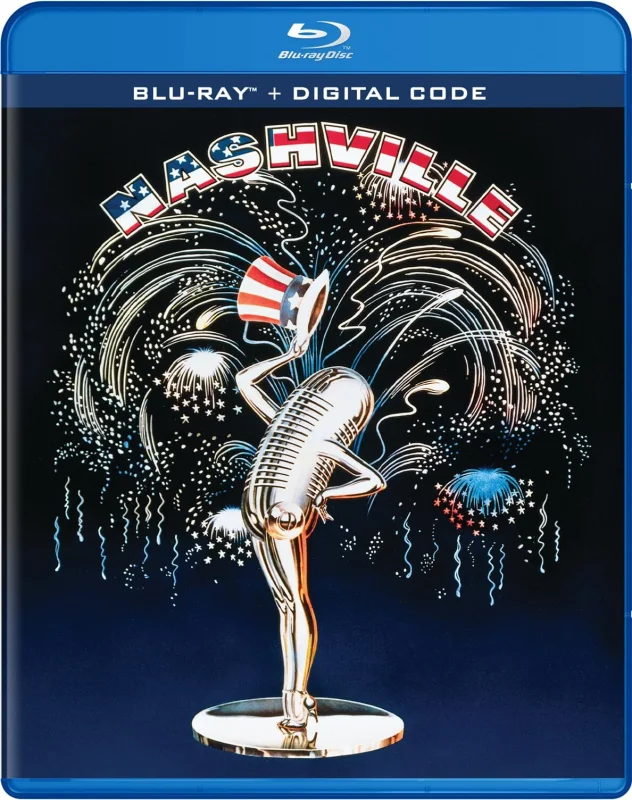




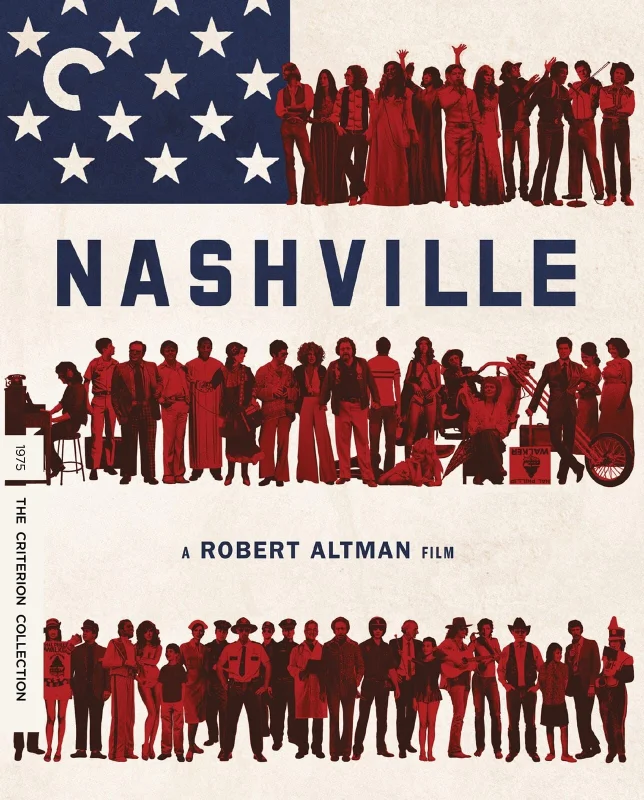
Nashville 4K 1975 Ultra HD 2160p
 Like
 Don't Like
A massive music festival is taking place in Nashville, and at the same time, a political campaign is underway to promote candidate Hal Philip Walker. He heads the newly formed “Party of Change.”
Walker’s aides, Michael Murphy and Ned Beatty, know what kind of people their candidate appeals to, and they’re trying to secure the support of several of the most famous country singers to help their cause.
User Review
The director used the somewhat cumbersome format of a nearly three-hour film only twice: in *Nashville* and *Short Cuts*—and, it must be said, it fully justified itself. It was *Nashville* that marked the director’s first attempt to capture a panorama of American society’s mores within a decentralized, rhizomatic composition. *Boogie Nights* and *Magnolia* had not yet been made, but it is no surprise that Altman gained followers precisely for his use of this formal structure. To some, such innovations seemed superfluous, and *Nashville* appeared to them as a plotless, characterless jumble. Of course, one cannot deny that many of the musical numbers could have been cut to slightly shorten the runtime, but ultimately Altman brilliantly succeeded in capturing the very essence of America, which often manifests itself precisely in mass events that combine entertainment with ideological propaganda.
The city of Nashville itself, as the center of a country music festival, becomes, in the director’s vision, the center of social and political life—the soul of the people, over which a serious ideological struggle is being waged. Minor characters swarm through the film like insects drawn to prey; that prey is money and fame, and their desire is to become part of the show that life has turned into. Some, in order to get on the show, are willing to do anything—even if they lack a voice or a sense of pitch—going so far as to striptease in front of a crowd of lecherous men. Others, having already tasted fame, squander their lives on dubious pleasures: before they’ve even had time to switch sexual partners, they’re already calling other candidates. Still others, like the shrewd British journalist played by Geraldine Chaplin, are ready to worm their way into any situation that smells of a scoop.
Surprisingly, despite the multitude of characters and extras, the individual stories do not get lost in the general hubbub; the characters remain memorable. Altman succeeds—perhaps for the first time since Eisenstein’s *Strike*—in making the people themselves, the masses, the nation, the hero; in the finale, after the incident has unfolded, they sing that nothing matters to them. “Nashville” is an incredibly compelling demonstration of how entertainment and propaganda work hand in hand. It’s worth noting that social media and the Internet don’t exist yet; the media is developed, but not to the extent it is today. It’s important that in this mosaic-like narrative, where everything is equally important, alongside the storylines there are snippets of TV and radio broadcasts, songs, and speeches. And everything here serves a single purpose—to provide as broad and comprehensive a panorama as possible of the life and customs of American society.
It seems that the 1960s—with their political activism and the involvement of most of society in ideological struggles—are behind us; so why, then, does the crowd in the finale sing that they don’t care? The entire two hours and forty minutes of the film are the answer to that question. When choosing between politics and entertainment, people prefer entertainment. The simplicity of country songs—sentimental and straightforward—not only expresses the soul of the people but also acts as a painkiller (in a similar way, Altman believes, do religious songs and religiosity in general). At times, it’s quite difficult to tell who is playing whom: some celebrities play themselves, such as Elliott Gould or Julie Christie, as do country singers; while the roles of certain celebrities are played by actors. Karen Black is particularly impressive here, beautifully singing songs she wrote herself (she is the very same actress who starred in Rafelson’s *Five Easy Pieces*).
*Nashville* is a veritable encyclopedia of life in the United States in the mid-1970s and one of the defining films of “New Hollywood.” It strikes me as the best film in Altman’s entire filmography. Nowhere else—neither before nor after—did this director manage to create such a compelling collective portrait of the society and era in which he lived. After all, despite the festive, show-like atmosphere, and despite the fact that we’re watching a festival combined with a political campaign, this is a deeply tragic film. Let’s not forget how it ends. And even the words of one of the characters—“This isn’t Dallas, it’s Nashville”—and the call to continue the concert are not merely a metaphor. This is a society where people step on each other’s heads, using one another for selfish ends; a world like a pigsty, deserving only of satire and sarcasm. However, these comic devices are not yet present here; the further along the film goes, the more Altman begins to use them, as evidenced by *The Wedding*, *Healthy Living*, and *The Player*. However, a film that is quite atypical for Altman—*Three Women*, shot between *Nashville* and *The Wedding*—also deserves a separate analysis.
Info Video
Codec: HEVC / H.265 (71.3 Mb/s)
Resolution: Native 4K (2160p)
HDR: Dolby Vision, HDR10
Aspect ratio: 2.35:1
Original aspect ratio: 2.39:1
Info Audio
#English: DTS-HD Master Audio 5.1 (48kHz, 24-bit)
#English: Dolby Digital 2.0 (Commentary by director/producer Robert Altman)
Info Subtitles
English SDH (PGS), French (Metropolitan) (PGS), Japanese, Spanish (Castilian), Turkish.File size: 84.68 GB