







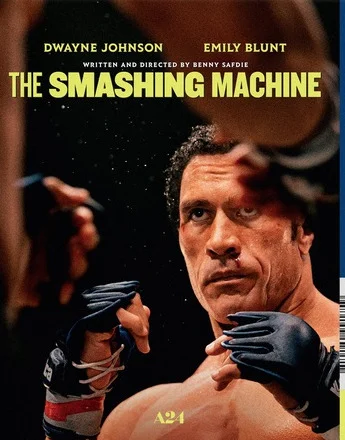
The Smashing Machine 4K 2025 Ultra HD 2160p
 Like
Like Don't Like
Dwayne "THE ROCK" Johnson will portray former MMA/UFC champion Mark Kerr aka "The Smashing Machine" in a story based on the true events surrounding Kerr's life and rise through the MMA world which was unfortunately derailed by his opioid addiction.
User Review
What do the Safdie brothers have in common with the Coen brothers? They also decided to take a break from each other. And while one of the Safdies immerses himself in the world of table tennis and the Shalam fan club, the other has ventured into the realm of mixed martial arts. His hero, Mark Kerr, is one of the first stars of this sport, a promoter of the UFC brand, and a man with a complicated personal life. At first glance, The Smashing Machine has all the attributes of a Safdie film: inventive parallel editing, a story about a man at a turning point in his life, plot revelations saved for the very end. But it's not that simple.
Mark Kerr is not a name on par with Conor McGregor or Jon Jones. He put his jaw on the line at a time when fighters fought just as hard for each contract as they did against their opponents in the octagon. MMA was far from the financial conditions of rock stars, and the image of strange fights balanced between quasi-criminal brawls and something kumite-like from Van Damme movies. There were no rules yet, most of today's prohibitions did not exist, and poking someone in the eye was considered a normal move. Mark Kerr drew crowds in Japan, but he could easily buy cereal in his native Ohio.
Despite the inflexibility of the sports biopic genre, Safdie draws three main plot conflicts from Kerr's story. His relationship with his friend, coach, and at the same time opponent in the octagon, Mark Coleman, another MMA pioneer. His undoubtedly toxic relationship with a rather vulgar lady played by Emily Blunt. And his relationship with himself, a man trapped in the huge body of a strongman. All three conflicts revolve around the victory-defeat dichotomy, which, let's be perfectly honest, is fundamental for any athlete.
And right away, a caveat. Dwayne Johnson tries. He really tries. Benny Safdie manages not only to stick curls on The Rock's shaved head, but also to squeeze dramatic emotions out of his meme-worthy face. Johnson's character is not one-dimensional. At the very least, the man in life and the man in the ring are two different sides of the same character. Which one is more convincing is, of course, another question. The sports component in The Smashing Machine is secondary. For a biopic about a legend (as if the genre doesn't work with others on principle), there aren't enough victories here. It's difficult for the viewer to understand why Kerr is singled out and not, say, Coleman. Incidentally, he is also played by someone who is not really an actor—MMA fighter Ryan Bader. And he is not the main sports star of the film; Usyk himself was lured into making cameo appearances.
The Coleman-Kerr conflict may lack precisely the kind of acting mannerisms and situations that can be enhanced with emotion or external charisma. The same cannot be said about the Skala-Blunt relationship. This extremely toxic, hysterical, spine-twisting love story is the backbone of the film. While the doors suffer, Blunt squeezes out her bitchiness to the max, but only to the extent of her affection for her huge man. This is exactly the kind of relationship where you feel sorry for everyone, but also sorry for no one. Where you know for sure that after a terrible fight, there will be the best sex in the world, and then another scandal that burns everything alive.
Finally, the main battlefield is Kerr's soul. Safdie throws the comparison of fights with orgasms into the mix. “When 40,000 people are shouting your name, they're all rooting for you, it's like ecstasy.” The general phlegmatic nature of anyone weighing more than 120 kg is almost synonymous with their inner world here. Outside the octagon, Kerr-Skala is an empathetic and thoughtful character. That's something you definitely don't expect from a brutal bruiser. Even after truly important words that MMA is not about hatred or even rage.
The Smashing Machine takes on too many tasks, failing to follow through on its stated meanings. He is a strong man, but what can he do if he is weaker than his own body? And is it worth it to get into the champions' heads when they get beaten up, and even into their beds, just to reflect on this? Is it really such a revelation that even great people have toxic relationships? And is the final message that losing can actually be a victory, a way out of a vicious circle, really that groundbreaking? For Safdie, yes, which is why, for example, Sinatra's My Way plays right in the middle of the film. Or the constant masquerading as a handheld camera, a kind of pseudo-documentary.
As a result, The Smashing Machine is more of a sad, viscous cinematic treatise on the fact that everyone's main conflict is with themselves. After victories, as well as after defeats, you are left alone with your own bruises. And it doesn't really matter whether you've been hit in the liver or wounded from within. Your defeat is always someone else's triumph. Therefore, the only crushing machine we have is life itself.
Info Video
Codec: HEVC / H.265 (77.9 Mb/s)
Resolution: Native 4K (2160p)
HDR: Dolby Vision, HDR10+
Original aspect ratio: 1.85:1
Info Audio
#English: Dolby TrueHD with Dolby Atmos 7.1 (48kHz, 24-bit)
#English: Dolby Digital Plus with Dolby Atmos 5.1
#English: Dolby Digital 2.0 (Commentary with director-writer Benny Safdie)
Info Subtitles
English SDH, Arabic, German, Portuguese (Brazilian), Spanish (Latin American).File size: 71.50 GB