



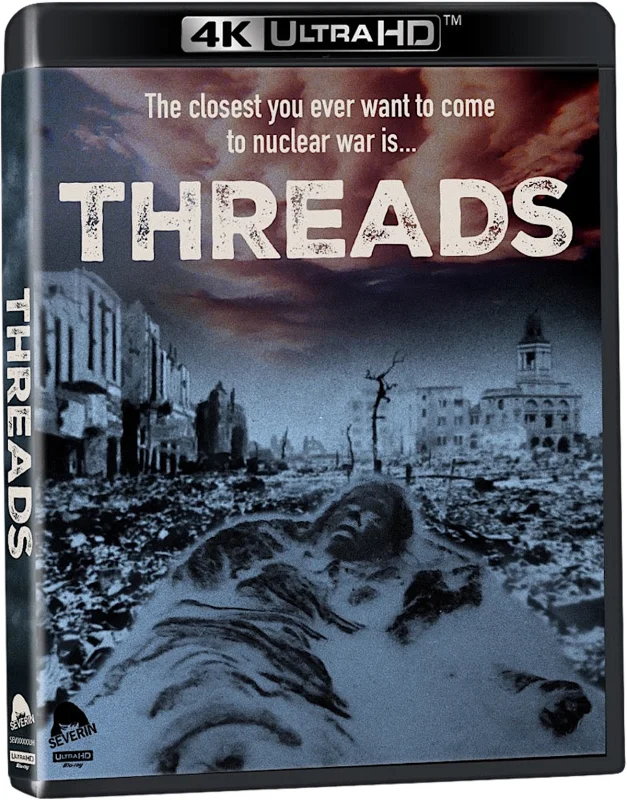
Threads 4K 1984 Ultra HD 2160p
 Like
Like Don't Like
The consequences of a nuclear disaster for the working-class city of Sheffield, England, and the possible long-term consequences of a nuclear war for civilization.
User Review
On the one hand, "Threads" is a work of science fiction in the alternate history genre. Sometime in the 1980s, the British town of Sheffield goes about its business. The town is home to steel mills and chemical plants, so while it isn’t particularly large, it is tied into the state—and, by extension, the global—system.
And now, the global system is making itself felt through snippets of alarming news on the radio and TV. Somewhere out there, in the distant Middle East, the USSR has gotten into a serious clash with the U.S. over fundamental disagreements regarding Iran. Actually, it was because of the conflict on Iranian soil that I watched this movie.
The superpowers start small but end up doing what everyone has feared since World War II. Meanwhile, in Sheffield, people are just chatting, making plans for their future, while the mayor tries to figure out whether he should activate emergency protocols or not. A young couple decides to move in together. She’s pregnant, and the young man has decided to take responsibility. Their parents were less than thrilled, but overall, they didn’t stand in their way. And so, while the young couple is peeling the old wallpaper off the walls of the room where they’ll live, the world is preparing to cross the line.
On the other hand, "Threads" is almost a documentary—it uses cinematic shots and characters solely to draw the viewer in. I remember when Trump first arrived at the White House and the military handed him the nuclear briefcase; the billionaire said he’d been shown some impressive footage of the consequences of a nuclear explosion and a hypothetical global nuclear war. It seems to me that even Trump was impressed back then.
So, "Threads" is very much like a demonstration of what the consequences of a British “Fallout” might look like. It’s as if someone commissioned a production for both the general public and a select audience. It’s also important to note that the pace accelerates from start to finish. While the film initially unfolds at the usual pace of a feature film—with a familiar exposition and setup, mundane everyday problems, character arcs, and a voice-over—after the nuclear catastrophe, events begin to practically flash before your eyes. 12 hours after the nuclear explosions, two days after the nuclear explosions, two weeks after the nuclear explosions, one year, ten years, and so on.
Why? What is the point of this approach? On the one hand, the consequences of nuclear war are presented concisely yet powerfully. The screen presents a stark, chilling distillation of what would happen if… And that’s all it takes! An extended version of the events following a nuclear war would no longer be an excursion into the hypothetical, but a post-apocalyptic film.
On the other hand, the idea may be that the accelerated pace hints at the collapse of everything. An avalanche has come down from the mountains, a uranium chain reaction has occurred, and… Nothing will ever be the same again.
The ending could be a moment where a single small episode signifies the extinction of humanity, or a sparse, dry, and cold demonstration of infant mortality. After all, both in the past—without today’s standard of living and medicine—and in such a sad and tragic version of the future, far from every baby was born alive and healthy.
Info Video
Codec: HEVC / H.265 (91.5 Mb/s)
Resolution: Native 4K (2160p)
HDR: Dolby Vision, HDR10
Original aspect ratio: 1.33:1
Info Audio
#English: FLAC 2.0
#English: FLAC 2.0 (Commentary by Director Mick Jackson, Film Writer Kier-La Janisse and Severin Films' David Gregory)
#English: FLAC 2.0 (Commentary by Actress Karen Meagher and Television Historian Simon Farquhar)
Info Subtitles
English SDH (PGS).File size: 73.72 GB