











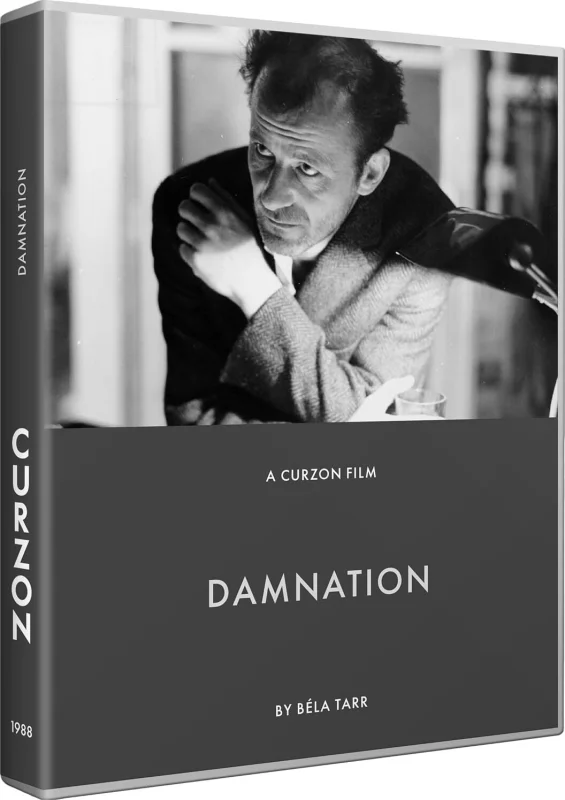
Damnation 4K 1988 Ultra HD 2160p
 Like
Like Don't Like
Karrer plods his way through life in quiet desperation. His environment is drab and rainy and muddy. Eaten up with solitude, his hopelessness would be incurable but for the existence of the Titanik Bar and its beautiful, haunting singer. But the lady is married and Karrer is determined to keep her husband away...
User Review
The style of the late works by Hungarian auteur filmmaker Béla Tarr is instantly recognizable and difficult to replicate: black and white, a slow pace and a stifling atmosphere, minimalism and realism. The attentive camera alternates between freezing in a state of stupor for several minutes and making a smooth transition from one shot to another with virtually imperceptible movements; the frozen stillness finds a compromise with the mesmerizing zoom. The minimal use of cuts emphasizes the somber, photographic quality, the sluggish pace, and the monotony of the scenes (for example, the seven-hour "Satanic Tango"—the director’s magnum opus—contains only 150 cuts). Realism and a semi-documentary portrayal of Hungarian life are synthesized with the metaphysical, existential themes of the monologues and the cosmic scope of the subject matter. The characters struggle to think and resolve ontological questions while sitting in the kitchen or at the local bar, succumbing to alcoholic delirium. In a prosaic, monochromatic domestic setting—which, in Tár’s work, is aesthetically beautiful—the voyeuristic camera captures their (often futile) attempts at reflection. But these are merely words. For the most part, the characters are passive, often incapable of making a decision or taking any action—whether spontaneous or deliberate—which explains the lack of plot and the near-total absence of action in Tarr’s films.
"Damnation" (1988) is the director’s first film belonging to his second and final creative period (unfortunately, in 2011, Tarr announced his retirement from filmmaking). It was with this film that his fruitful collaboration with László Krasznahorkai—a writer and screenwriter, his contemporary and kindred spirit—began. This creative partnership bore fruit in the form of such masterpieces as: the absurdist and Beckettian "Satanic Tango" (1994); the postmodern, Kafkaesque, and symbol-laden "Vermeester’s Harmonies" (2000); the noir "The Man from London" (2007); and the critically mixed "The Turin Horse" (2011). The starting point of their collaboration—a film about damnation and total doom—was well-received by art-house critics, won an award at the Bergamo Film Festival, became Susan Sontag’s favorite film, and brought the director well-deserved recognition and fame.
"Damnation" is a claustrophobic film. Space and time are compressed here, as are emotions, feelings, and action. The characters exist within the confined framework of the classical triad of place, time, and action. They are hardly remarkable. The plot is old and more than ordinary. From this worn-out clay, Tarr molds a mesmerizing story of love and crime.
The character we see most often on screen—Carrer (Miklós Székely)—is a passive alcoholic, a middle-aged man who is depressed and lacking in self-confidence. He possesses nothing material (no money, no job, no comfortable home). But he is driven by passion; he loves, and his character possesses both personal qualities and controversial, idiosyncratic traits. Carrer’s tragedy lies in the fact that his love is doomed. His beloved (Vali Kerekes) is the wife of the owner of a club with the telling name “Titanic.” A languid, frivolous singer, she sings her sad song within the dark walls of a smoke-filled room and thoughtlessly breaks hearts. Driven to a frenzy and madness by his unrequited love, the hero withdraws into himself and begins to ramble. Poetic dialogues, beautiful phrases, allegorical storytelling, the endless howling of dogs, rain, and fog as recurring motifs—all of this immerses the viewer in a depressing atmosphere of hopelessness and longing. Longing for reciprocity. Longing for a real life. Longing for oneself.
Through his film, Tarr shows that the causes of human misfortune lie in the very structure of the universe, in human existence itself. The director absolves people of responsibility; they are weak, helpless, and blind. Any human endeavors or attempts to change anything are, a priori, futile and doomed to failure. This is the essence of the film’s unbridled, suffocating fatalism. A vicious cycle from which there is no escape. An endless round dance of drunks in soggy boots on the sticky floor of a tavern. The hopeless darkness of loneliness in a dance to the rhythm of water droplets falling from the sky and shattering.
Info Video
Codec: HEVC / H.265 (82.1 Mb/s)
Resolution: Native 4K (2160p)
Original aspect ratio: 1.66:1
Info Audio
#Hungarian: FLAC 1.0
Info Subtitles
English SDH (PGS), Dutch, French (PGS), German, Hungarian SDH, Japanese (PGS), Spanish (Castilian).File size: 69.97 GB