



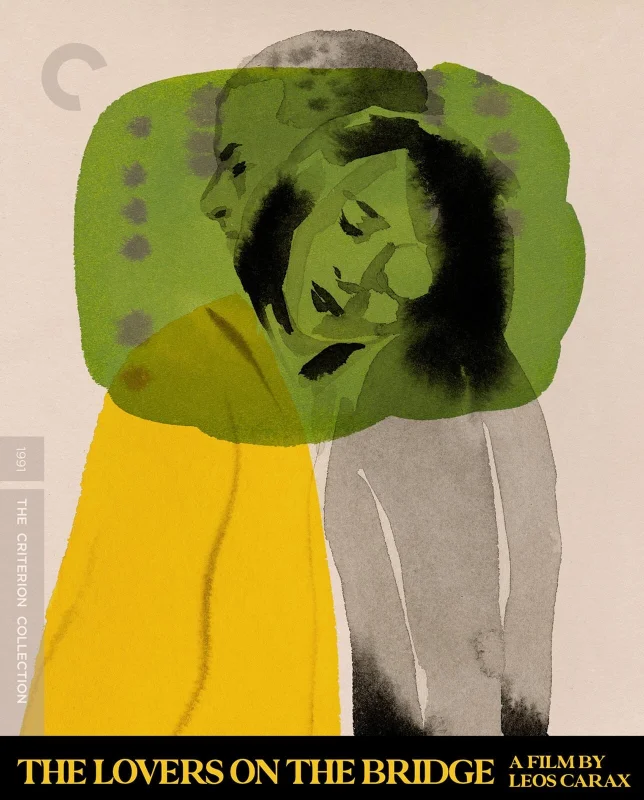
The Lovers on the Bridge 4K 1991 Ultra HD 2160p
 Like
Like Don't Like
Carrax tells us the incredible love story of two Parisian homeless people—Alex and Michelle—who managed to find each other in an environment where such a tender feeling would seem utterly unthinkable, where trials lie in wait at every turn, yet the taste of freedom, despite everything, is unforgettably poignant. On the margins of life, people are capable of feeling things with particular intensity. And suffering, like love, takes on a completely different meaning here…
User Review
He lay in the middle of an empty highway stretching into the dark void—just like his entire aimless life. The girl stood there, staring intently at his ugly, disfigured face, shamelessly illuminated by the glare of Paris’s night lights. And a day later, on a white sheet of paper, he suddenly locked eyes with his soul—a grimace of horror and pain that had suddenly revealed itself then to her blinding yet still keen eyes. Thus began the story of their love, and with it, this crazy, ugly, irresistible—and strange—film: neither reality nor a fairy tale, but a bizarre fusion of life turned inside out and romantic dreams. This is how French director Leos Carax sees the world.
“The Lovers on the Bridge” is a film that’s an oxymoron. In it, everything seems to teeter on the brink of a nervous breakdown, a sharp, almost jarring contrast. Paris is somehow semi-real, as if it had stepped straight out of Impressionist paintings: grotesquely beautiful, like the artificial glow of nighttime lights, and exaggeratedly ugly, like the dirty, battered bodies in a city flophouse. That’s where Alex comes from—a destitute acrobat and fakir, accustomed to playing with fire. Dénis Lavant’s character, a sort of ecstatic neurotic, is just as “disembodied” in everyday life as Michelle, the homeless artist who is losing her sight. She tries, but still cannot finish his portrait: and the problem is not even her eyes, which can barely see anymore, but rather that inner discord, that painful brokenness, which unites these two strange beings. They are like that broken bridge—a symbol of their union—half-ruined, filthy, yet, like the distorted face of Juliette Binoche’s character, still retaining traces of its original beauty—the beauty that Alex and Michelle unerringly see in each other beneath the scab of despair and fear. Much like Bertolucci’s “The Conformist,” Carax’s characters also take a sort of time-out from life, shutting themselves away in the secluded space of their stone refuge above the water, where their “loneliness” turns out to be, in fact, a paradoxical closeness, and their pain—a path to healing.
For Michelle, who has condemned herself to poverty, this life beyond social norms and conventions—as if on the edge of humanity—reveals itself as an experience of true freedom. She and Alex are precisely those Gospel-story Good Samaritans (the glowing sign above the bridge) who, in the blink of an eye, found themselves closer to the truth than the “orthodox” and successful representatives of this age. The sense of victory over everyday hustle and bustle and hypocrisy in the film symbolically corresponds to the memory of the days of the French Revolution. Paris celebrates its triumph with a rhythmic military march and the monotonous hum of aircraft. And as if in response, shattering all rules and restrictions, the irrepressible, mad laughter of Alex and Michelle rings out, while their bodies twist in the whimsical movements of thoughtless, ecstatic dances. This spontaneous rapture of experiencing true “equality and brotherhood” with the whole world is lost in the dazzling beauty of the city at night, whose true face is revealed right now—against a backdrop of endless fireworks, continuously phosphorescing with shimmering colors and streams of iridescent light. Such is the true Paris—the soul of the city, brought to life by the director’s imagination, and at the same time a manifesto of a kind of primal, Bacchic freedom.
But the city in the film is also a living, constantly changing participant in the action. The director seems to borrow the age-old principle of parallelism from folklore. Frame by frame, Paris mirrors its characters, reflecting what is happening in its own way. Thus, their separate lives are depicted as a succession of long, endless underground passages: empty, gray, and dreary. Their meeting is like two lonely streetlights on a bridge: battered but not broken, they are still capable of lighting up and, merging into a single bright spot, illuminating the space around them. Their union is marked by the cheerful clatter of an amusement ride sparkling with multicolored lights, while the exhilarating rhythms of a nighttime disco drown out the drawn-out, melancholic vibrato of a lonely cello. Their separation evokes the pale ceilings and yellow walls of a prison... In this enchanting city—whether it be purgatory or a Jarmusch-esque otherworld—two restless souls wander, as if doomed to wander until the moment of a final choice between despair and hope, ugliness and beauty, the hell of sleepy oblivion, and the “paradise” of the distant chimes of bells heralding the dawn of a new day.
Snowflakes cover the renovated bridge, now teeming with cars. Paris, sparkling under the light of the streetlamps—now completely different, neat and clean—looks upon the transformed Michelle, who stands over Alex, lying in the middle of the road, and smiles. And then she paints his portrait, and they laugh again with that silly, reckless laughter, the secret freedom and charm of which are known only to the two of them—and, perhaps, to Leo Carax himself, an incurable romantic and rebel. He continues to fight the windmills of practicality and rationalism, to idolize Dostoevsky, and to believe sacredly in love “until the very end”...
Info Video
Codec: HEVC / H.265 (91.6 Mb/s)
Resolution: Native 4K (2160p)
HDR: Dolby Vision, HDR10
Aspect ratio: 1.66:1
Original aspect ratio: 1.66:1
Info Audio
#French: FLAC 2.0
#French: DTS-HD Master Audio 5.1
Info Subtitles
English (PGS), Chinese (Traditional), German, Japanese (PGS), Portuguese (Brazilian), Portuguese (European), Spanish (Castilian), Turkish.File size: 85.11 GB