










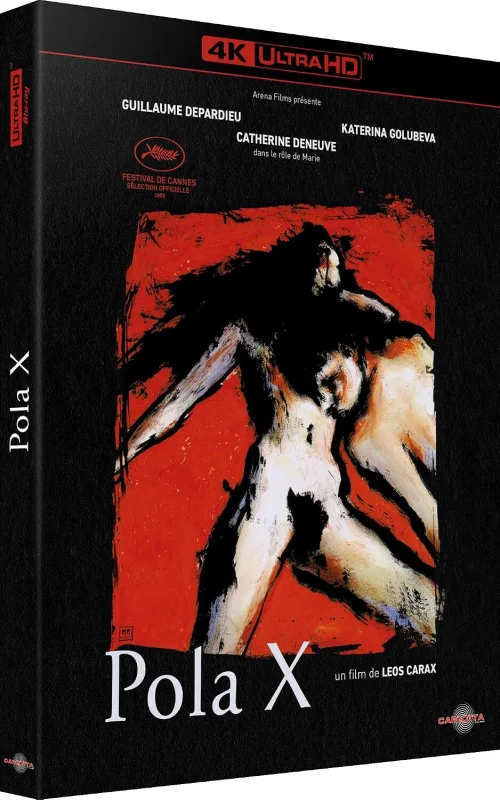
Pola X 4K 1999 Ultra HD 2160p
 Like
 Don't Like
The carefree life of the wealthy Pierre and his mother Maria seems as unshakable and unswervable as the walls of their luxurious home. A short story by Pierre, published anonymously, becomes a hit, and he himself is ready to enter into a long-awaited marriage with his cousin, the beautiful blonde Lucy. But a strange encounter on a forest road with a dark-haired vagrant radically changes Pierre’s fate. The mysterious traveler reveals her secret to him: she is actually his sister Isabelle, abandoned by their father.
The young man’s world is suddenly turned upside down; something compels him to believe this woman, and he resolves to do the impossible. Pierre leaves Lucy and his overprotective mother and, together with Isabelle, heads to Paris to discover the dark sides of human nature.
In the suburbs of the big city, they find refuge in a mysterious society. Pierre’s relationship with Isabelle goes beyond that of siblings. Lies, hypocrisy, wild passion, and all-consuming love turn the lives of the two young people upside down, throwing them into the millstones of a treacherous fate.
User Review
Cult French director Leos Carax, a pioneer of the “Newest New Wave,” returns to the big screen after an eight-year hiatus and period of seclusion with a modern adaptation of Melville’s novel *Pierre, or Ambiguities*, written way back in 1852. The film was presented in the competition program at the Cannes Film Festival but failed to win over critics, becoming one of the director’s biggest flops. Carrax makes no secret of the fact that during filming he was inspired by Dostoevsky’s *The Adolescent*, a work that has always fascinated him and, as a result, left an indelible mark on this film.
Tormented by contradictions and the search for a truth that may not even exist—and that perhaps no one needs at all—his protagonist, the alter ego of French cinema’s “enfant terrible,” travels from one film to the next. Carax remains true to himself: his films are always filled with alienation and loneliness. *Pola X* depicts the artist’s suffering, overflowing with suicidal tendencies, which he applies to the cinematic canvas with calligraphic precision. All the director needs to do is place a passive sociopath in a marginal, oppressive environment so that, due to his immaturity and infantilism, he fights “windmills” until nothing but ruins remain of him.
Carrax inclines the viewer toward melancholic reflections, mesmerizing and captivating them with his visual imagery, playing on the contrast between black and white; yet the story he tells is more reminiscent of the ramblings of a madman who has long been under the influence of psychotropic drugs and Brazilian soap operas. And it’s unclear whether the fault lies with Herman Melville or with Leos. Returning after many years of complete oblivion, his half-sister rescues Pierre from the bondage of aristocracy and leads him into a world of the irrational, where he is destined to lose his way in the impenetrable wilderness of his own self. Why does he decide to renounce worldly pleasures in favor of passionate suffering? Perhaps not even Carax knows the answer. Logic and motivation take a back seat when emotions come to the forefront.
This emotional torment escalates into an illness, but the ailment is caused by self-flagellation that lacks any solid foundation. It simply has to be this way; simply put, if the dreamer Pierre hadn’t waged war against the “bourgeois” world, hadn’t sworn allegiance to a social class foreign to him—an oath that led him to existential death—then there would have been no inner rebirth of the hero, and Carax might have missed the opportunity to show an unsimulated sexual act between the son of one of France’s most popular actors and Katya, who, years later, would repeat her pornographic experience once again.
The film features a remarkable line that reveals its underlying meaning: “You cannot harbor animosity toward your world and think that you will not be punished by it for doing so.” The naive Pierre firmly believes that his destiny is to rise above the transience of life, but instead of the long-awaited epiphany, only disappointment awaits him. Love does not save him, because it was doomed from the start, and there is no turning back. Left alone with his hopelessness, he finds an escape in complete self-destruction. Karkas has an inexplicable penchant for “suicide,” which takes on ever-greater proportions with each new film, but perhaps it’s time to stop and make something more life-affirming, rather than trying for the hundredth time in a row to sink a “ship that’s already sinking.” Behind the spectacular cinematic techniques lies yet another clichéd story in which the protagonist is bound to suffer.
Info Video
Codec: HEVC / H.265 (74.2 Mb/s)
Resolution: Native 4K (2160p)
Aspect ratio: 1.66:1
Original aspect ratio: 1.66:1
Info Audio
#French: DTS-HD Master Audio 5.1
#English: FLAC 2.0 (Commentary by actor Guillaume Depardieu)
Info Subtitles
English, French (Metropolitan) SDH (PGS).File size: 73.20 GB