


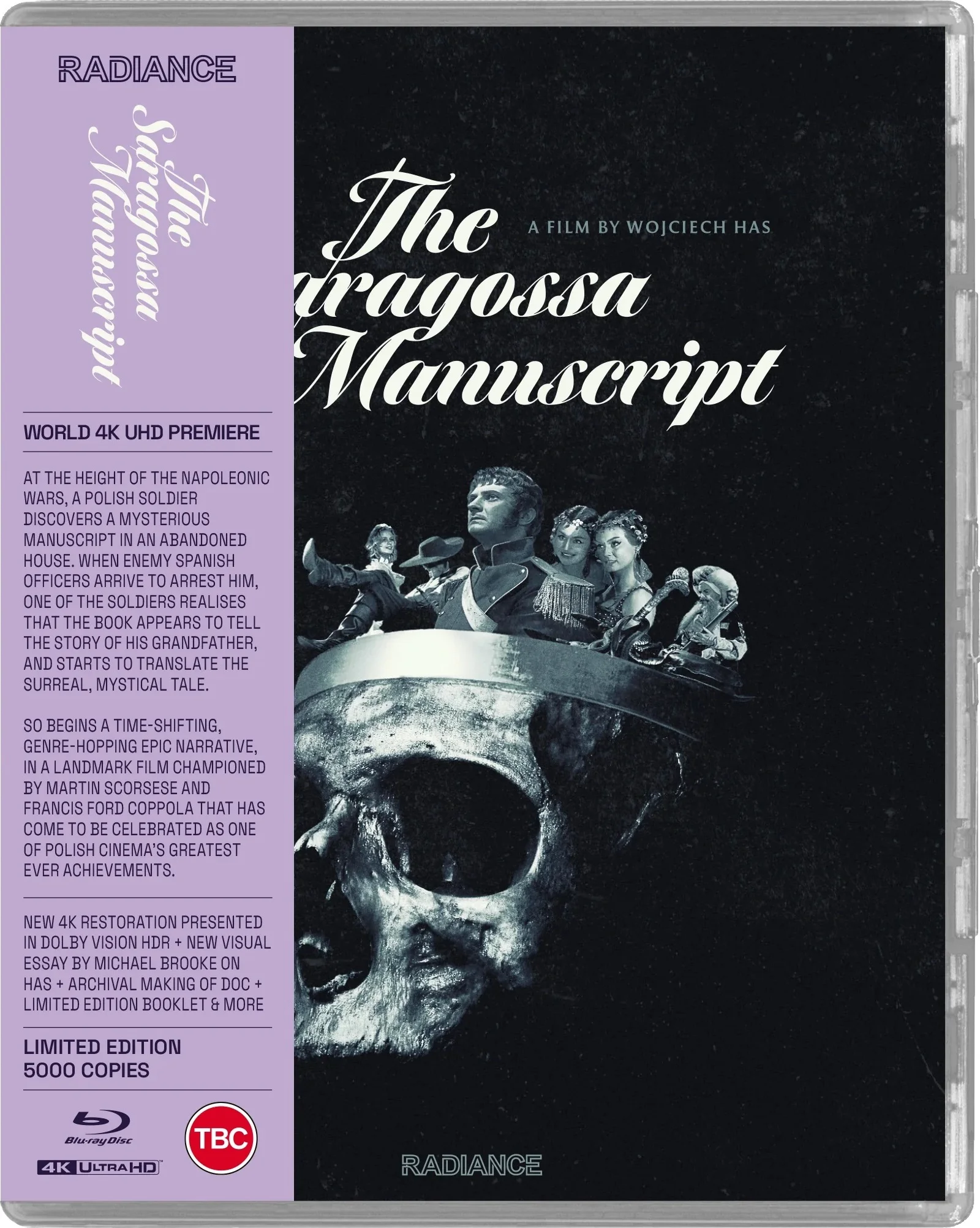
The Saragossa Manuscript 4K 1965 Ultra HD 2160p
 Like
Like Don't Like
After finding a book that tells the story of his grandfather, the officer sets off on a journey through Spain, meeting a wide variety of characters, most of whom have their own stories to tell.
User Review
Hassa’s film is a mystery—a labyrinth within a labyrinth. First and foremost, it’s a film with a dual protagonist. Who is the main character? Formally, it’s Alphonse van Vorden. But what about that officer reading a book in the film’s opening scene? Maybe he’s the hero? The film’s title—*The Saragossa Manuscript*—offers a clue. The title is a spoiler. Essentially, everything is encapsulated in it. It’s an adventure without an adventure, for the characters never move anywhere and constantly return to the film’s starting point—a sort of “Aleph,” where the world is concentrated. A similar structure was already laid out in Pototsky’s novel—a novel that people compared to everything except what it actually resembles: Cervantes’ *Don Quixote*. Long before Pototsky, Cervantes wrote a parody of the chivalric novel, and the result was a structure of the world—a novel within a novel—that can have no end and constantly returns to the starting point where the universe is concentrated. In his film, Haas refuses to play with mirrors; he takes as his basis not the canonical text *14 Days in the Life of Alfonso van Worden* (which partly parodies Romanticism), but the stories that complement it. Haas’s roguish film draws on Pototsky’s universe but uses it as the foundation to create a new work (or works!) . After rewatching it, I surmised that this kind of structure is characteristic of Raul Ruiz’s films. And I was right. Ruiz drew on Pototsky in his film *A Journey Around the Hand* (a charming title for an adventure novel), which is a film adaptation of a single chapter from the novel. As a postmodernist with limited funds, instead of a grand adventure (Hass’s film runs 3 hours), Ruiz concentrated everything into a single point—an idea: he embodies the conception of the world as a gigantic human body, inside which people live. And he told this story in less than half an hour.
Hassa’s film perfectly illustrates Rob-Grier’s idea of the world’s objectivity. For him, things are things-in-themselves that are viewed not by the characters in the narrative, but by the audience. It is interesting to examine them in isolation from human beings. The film *The Saragossa Manuscript* is also a thing-in-itself.
In the Second Manifesto of Surrealism, André Breton suggested that there is a certain point in the human soul where life and death, the real and the imaginary, no longer exist as opposites. Hassa’s film is also about the nature of duality—where doubles are not opposites but constitute a single “mirrored whole.”
Info Video
Codec: HEVC / H.265 (66.1 Mb/s)
Resolution: Native 4K (2160p)
HDR: Dolby Vision, HDR10
Aspect ratio: 2.39:1
Original aspect ratio: 2.39:1
Info Audio
#Polish: FLAC 1.0
Info Subtitles
English (PGS), French (Canadian) (PGS), Polish SDH (PGS), Spanish (Castilian).File size: 85.89 GB