



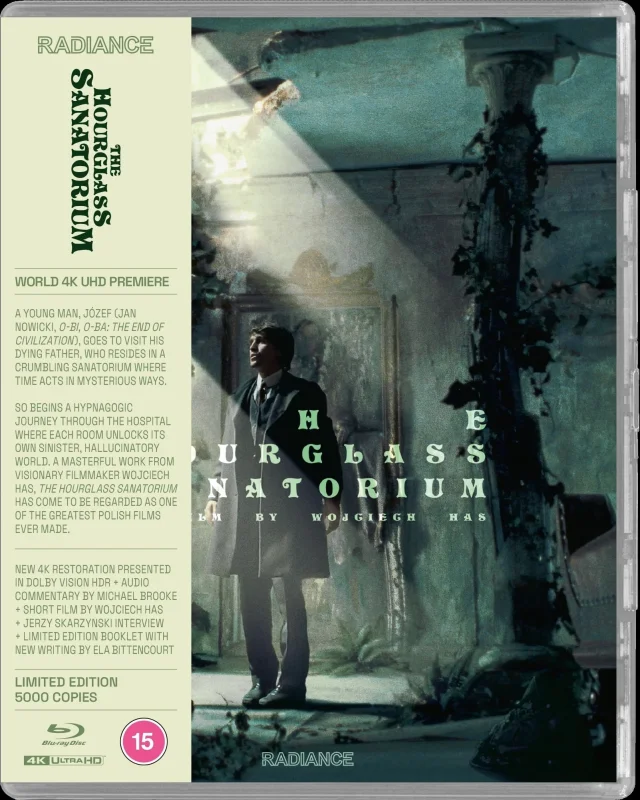
The Hourglass Sanatorium 4K 1973 Ultra HD 2160p
 Like
Like Don't Like
The film depicts its protagonist, Joseph (Jan Nowicki), traveling through a dream-like world, taking a dilapidated train to visit his dying father in a sanatorium. When he arrives at the hospital, he finds the entire facility is going to ruin and no one seems to be in charge, or even caring for the patients. Time appears to behave in unpredictable ways, reanimating the past in an elaborate artificial caprice.
User Review
Wojciech Has, who studied at the Academy of Fine Arts in Kraków, brought his distinctive graphic approach to seeing and depicting reality and fiction to the world of cinema. At the same time, the combination of a formalistic, plotless style with the “cool, detached imagery” characteristic of all Polish (and indeed, the entire Eastern Bloc) cinema lent his works a certain Gothic atmosphere of mystery.
“The Hourglass Sanatorium”—which, incidentally, was based on the short stories of Polish writer Bruno Schulz (who perished in a Jewish ghetto during the war against the Nazis)—bears clear signs of being a follow-up to another of Has’s works, “The Saragossa Manuscript,” released eight years earlier. These films are linked not only by the shared unreality of the events, but also by a certain personal message imbued with Kafkaesque absurdity.
The film’s protagonist, lost in the labyrinth of his own dreams, easily “flips” from the past to the present, communicating with his deceased parents and freely wandering through the expanses of his own past. It’s hard to even say whether the film’s central character is dreaming or if he, too, has already died. The asceticism of the slow-moving action—and the near-absence of a plot—seems like the director’s attempt to depict “frozen time” through the “language of cinema.”
The film’s main strength lies in its visual design (not surprisingly, given that the director was formerly a visual artist), with a sequential chain of scenes depicting the protagonist darting through space. In an instant, after crawling under the bed, he emerges from the other side, miraculously finding himself in the market square. And so it goes throughout the film: these cinematic transitions disrupt the linearity of space and time. Meanwhile, the Jewish ritual elements that run like a thread through the entire plot provide at least some structure to the film’s rather elaborate and surrealistic form.
Info Video
Codec: HEVC / H.265 (94.9 Mb/s)
Resolution: Native 4K (2160p)
HDR: Dolby Vision, HDR10
Aspect ratio: 1.85:1
Original aspect ratio: 1.85:1
Info Audio
#Polish: FLAC 1.0
#Polish: FLAC 1.0
#English: Dolby Digital 2.0 (Commentary by Polish film expert Michael Brooke (2026))
Info Subtitles
English (PGS), French (Canadian) (PGS), French (Metropolitan), Polish SDH (PGS), Spanish (Castilian), Ukrainian.File size: 83.62 GB