

Toy Story 5 4K 2026 Ultra HD 2160p
 Like
Like Don't Like
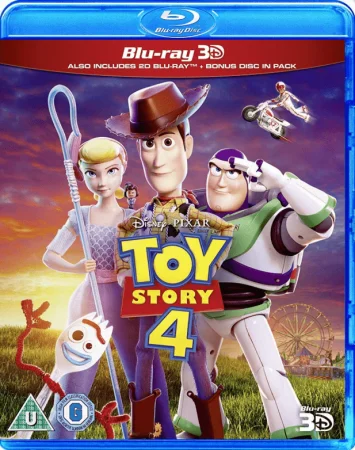
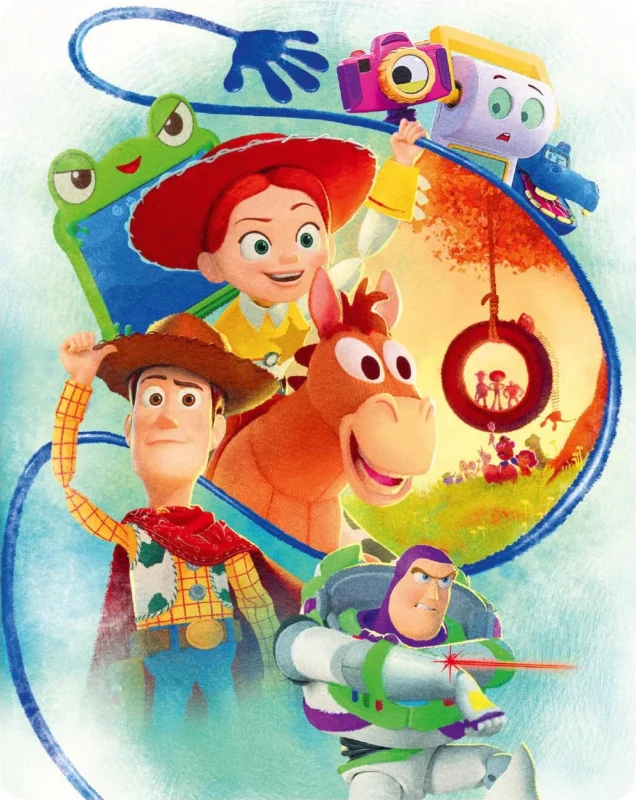
Woody the cowboy, Buzz Lightyear the astronaut, and their friends will face off against a frog-shaped kids' tablet. The toys must do everything they can to keep their owner, a little girl named Bonnie, interested.
User Review
I’ll be honest: when they announced the fifth installment, I rolled my eyes. I mean, how much more can they do? The third one was the perfect ending—I was in tears along with the whole theater back then. The fourth one already felt like an unnecessary add-on. And now the fifth one. My first thought: Pixar is milking a cow that ran out of milk back in 2010. That’s the mindset I had when I sat down in my seat. And you know what? Twenty minutes in, my skepticism had evaporated, and by the end, I was once again sitting there with treacherously wet eyes. I guess I’m getting old.
Let’s start with the main thing—the theme. It strikes a chord with the spirit of the times: the clash between good old-fashioned toys and the world of gadgets that have captured children’s attention completely and utterly. And here, the film does something I didn’t expect: the opening is set in an unsettling, almost oppressive tone. Rows of children with their heads uniformly buried in their screens, completely indifferent to the world around them—Pixar shows this without a single word of condemnation, simply observing, and this observation makes you feel uneasy. For a second, I forgot I was watching a children’s animated film. And that’s a masterstroke, because every parent in the theater recognized their own living room.
The second surprise is that the balance of power among the characters has shifted—and noticeably so. The franchise veterans step aside to make way for a character who has remained in the shadows all these years—and this is the best decision the screenwriters have made in the last two installments. Finally, this heroine has been allowed to be not just someone’s sidekick, but the full-fledged center of the story: with her own fears, her own memories, and the inner conflict of a toy who knows the price of being forgotten. I’ve been waiting since the third movie for her to really shine. My wait is over. And the jokes about the old guard’s age are a special treat: funny and poignant at the same time, because we—who grew up on the first few movies—aren’t exactly kids anymore either.
There’s also a plot twist in the relationships between the long-standing characters that genuinely surprised me. Without going into details: it turned out to be much warmer and more honest than I expected—and it’s presented without contrived drama, in a mature way. Who would have thought that a children’s cartoon would teach such a lesson about mature relationships?
A particular delight is a large-scale scene featuring a whole squad of familiar characters in their new incarnations, which echoes a classic scene from the first film. The circle is complete, and it’s done without any annoying winks at the audience. Longtime fans will catch the reference instantly, while newcomers will just laugh—it works for both audiences.
Now, as for why it doesn’t get a perfect 10.
First, the middle drags—they could have easily cut about fifteen minutes. Second, the film occasionally veers into preaching. The idea that “it’s not about technology, but about a sense of proportion” is valid, but it’s repeated so many times that by the end you just want to beg: “We’ve learned the lesson!” And third, the resolution plays it safe—it’s as if the creators were afraid to choose between a bitter, bold note and a sweet happy ending, so they ended up taking the middle ground. After the epic scale of the third installment, this feels like a step backward.
But all of this is trivial compared to the main point: the technical execution here is mind-blowing—the texture of the fabric, the scuffs on old plastic, and the dust in a sunbeam are rendered with almost tangible realism. The humor works on two levels: kids laugh at the absurd new characters, while adults chuckle at the jabs about the characters’ ages, recognizing themselves in them. And the most valuable thing is the message. Not “throw away your phones,” but “find a balance.” The film honestly answers the question the franchise has been asking itself for thirty years: what does it mean to be needed?
And after the screening, I caught myself not reaching for my phone the entire evening. It seems this is exactly the effect the creators were aiming for.
And here’s what I realized on my way home. The secret to *Toy Story*’s enduring appeal is that each installment answers the same question anew—what to do when you’re no longer loved—but each time in the language of its own era. In the ’90s, it was jealousy of a new toy; in the third installment, it was the owner growing up; and now, it’s an entire era in which the rival isn’t another cowboy, but a glowing screen. The franchise is aging alongside us and speaks to each generation about its own fears—which is why it never gets outdated.
Not the best installment in the series. But a worthy one. And for a story that’s more than thirty years old, that’s already a small miracle.
Info Video
Codec: HEVC / H.265 (63.1 Mb/s)
Resolution: Native 4K (2160p)
HDR: Dolby Vision, HDR10
Aspect ratio: 1.85:1
Original aspect ratio: 1.85:1
Info Audio
#English: Dolby TrueHD with Dolby Atmos 7.1 (48kHz, 24-bit)
#English: Dolby Digital Plus 7.1
#Spanish (Latino): Dolby Digital Plus 7.1
#French: Dolby Digital Plus 7.1
Info Subtitles
English SDH (PGS), Arabic, Bulgarian, Chinese (Cantonese), Chinese (Traditional), Croatian, Czech, Danish, Dutch, Estonian, Finnish, French (Canadian) (PGS), French (Canadian) SDH, French (Parisian) SDH, German SDH, Greek, Hebrew, Hungarian, Icelandic, Italian, Korean, Lithuanian, Norwegian, Polish, Portuguese (Iberian), Slovak, Slovenian, Spanish (Castilian), Spanish (Latin American) (PGS), Swedish, Turkish, Ukrainian.File size: 49.94 GB