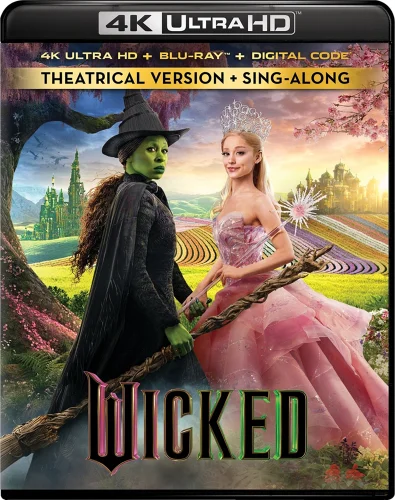


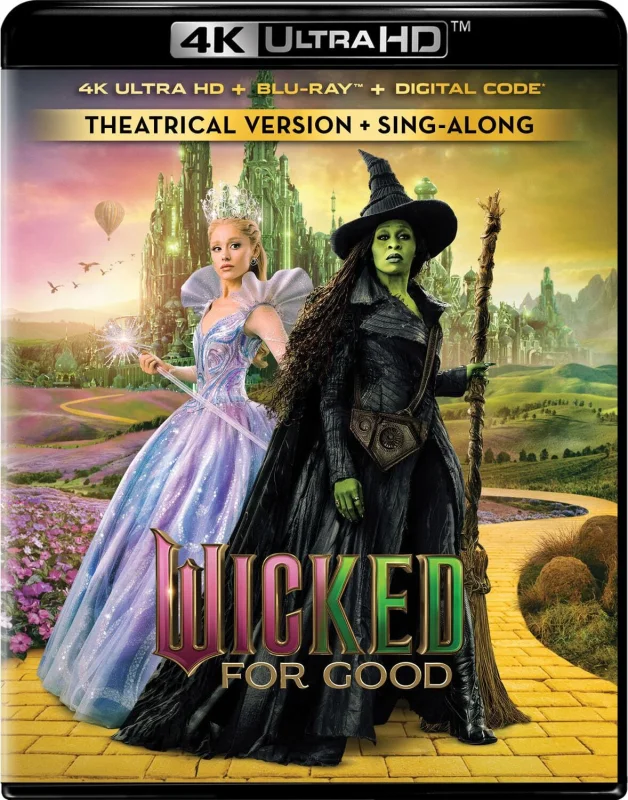
Wicked: For Good 4K 2025 Ultra HD 2160p
 Like
Like Don't Like
After challenging the Wizard's totalitarian regime in Oz, Elphaba must grapple with her identity as the "Wicked Witch of the West." Meanwhile, the Wizard has given Glinda the title "Glinda the Good" and a public status as the nation's defender against Elphaba. The two witches must make decisions that seal their fates in this second musical installment.
User Review
People are arguing about the same things regarding the second part of Zloy: there are fewer jokes, it's too long, and the first part seemed livelier. But if you look at the film not as “just another New Year's musical,” but as a continuation of the myth, the feeling is completely different: the splendor of the first part has not disappeared, it has simply shifted focus.
The first “Maleficent” was in love with its own world — with magic, costumes, witty dialogue, and playing with the audience's expectations. The second remains in the same universe, but switches the camera: now the focus is not so much on the personal story of the girl with green skin, but on the mechanics of power, propaganda, and collective fear. This is no longer just a fairy tale about two witches—it is a film about internal politics disguised as a family musical.
Yes, in terms of the density of jokes, the film is inferior to the first part. There, the gags came almost without pause, here the humor is no longer the engine, but an ambulance: there is enough of it so that the viewer does not suffocate from the seriousness of what is happening, but it is no longer the main reason for the film's existence. The energy goes elsewhere—into the subtext.
We see how the system constructs the enemy. Elphaba is turned into a monster, and a cult of horror is built around her name. Animals are deprived of their voices – literally and metaphorically. First, their mouths are covered, then they are deprived of their right to be a full-fledged part of the world. Glinda, in turn, is transformed into the shining facade of the regime – a “kind,” convenient, smiling figure who is supposed to reassure people and legitimize what is happening. The Wizard and Morrible rule not so much a country as a mass spectacle—announcements, rallies, the official version that everyone repeats.
The film simultaneously talks about politics and pretends to be empty. Some things are said in whispers, hints, and some things are said completely bluntly. For a child, it will be a story about injustice and choice; for an adult, it will be a recognizable set of techniques used by the state to turn anyone who refuses to play by the rules into a “witch.”
Against this backdrop, it is particularly interesting to look at Maleficent: Mistress of Evil through Jung.
Here, you don't need a magnifying glass to find the archetypes—they're almost on the surface.
Elphaba is the Shadow and the Outcast, that piece of truth and conscience that society pushes away. Her “evil” is not innate evil, but a reaction to the total refusal to see and hear her.
Glinda is the Persona, the mask of the “good girl” and the darling of the crowd. Her path is from a pure thirst for recognition to an attempt to take on at least some responsibility without destroying her own image.
The Wizard and the system are the false Father, the fake wise Old Man: power without wisdom, authority without truth.
The animals are the repressed Logos, the mind and spirituality of the world, which is easier to declare “inferior” than to listen to.
You don't have to know Jung to feel all this. But if you look at it from this perspective, it becomes clear why the film works so well for both children and adults. For one viewer, it will be a story about “being different doesn't mean being evil,” for another, it will be about the price of choice and how sometimes it is easier to believe in a simple fairy tale about a monster than in the complex truth about oneself and one's society.
I think the problem is not that the sequel is weaker. Rather, it is that we are used to evaluating films based on the principle of “plot - pace - how many times the audience laughed,” and much less often look at what they are actually trying to tell us. And if you look at it that way, you can criticize the second part for anything—its length, its imperfect pace, its lack of jokes. But I can't bring myself to call it a mediocre sequel.
This is a film that knows how to smile at a child and wink at an adult at the same time, making it very clear that real magic is not green skin and spells. Real magic is the courage to be yourself when the whole world has already agreed that you are a monster.
Info Video
Codec: HEVC / H.265 (68.8 Mb/s)
Resolution: Native 4K (2160p)
HDR: Dolby Vision, HDR10
Original aspect ratio: 2.39:1
Info Audio
#English: Dolby TrueHD with Dolby Atmos 7.1 (48kHz, 24-bit)
#English: Dolby Digital 5.1
#Spanish (Latino): Dolby Digital Plus 7.1
#French: Dolby Digital Plus 7.1
Info Subtitles
English SDH, Cantonese (Traditional), Chinese (Traditional), Danish, Dutch, Finnish, French (Parisian), French (Canadian), German, Hindi, Indonesian, Italian, Korean, Malay, Norwegian, Portuguese (Brazilian), Spanish (Castilian), Spanish (Latin American), Swedish, Thai.File size: 71.36 GB