
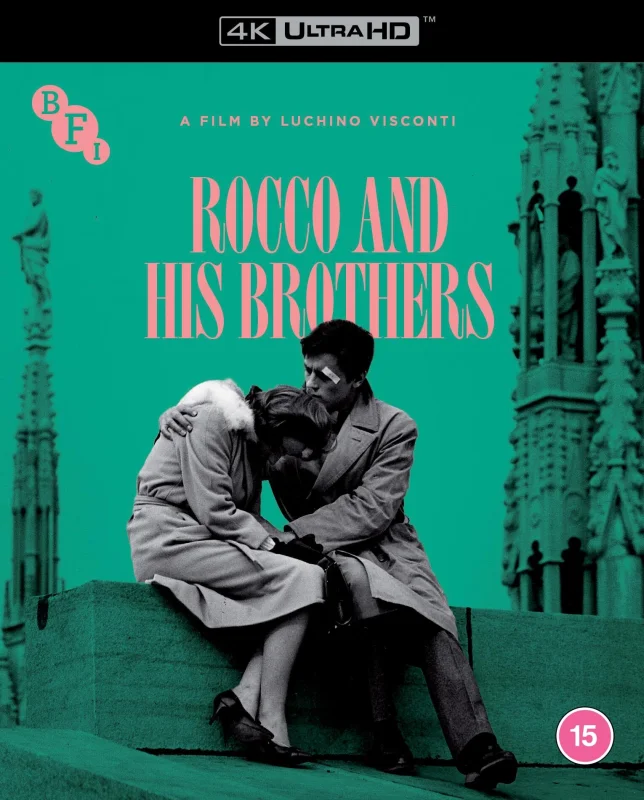
Rocco and His Brothers 4K 1960 Ultra HD 2160p
 Like
Like Don't Like
This cinematic novel tells the story of the Parondi family, who moved from the impoverished South to industrial Milan, and of the brothers Simone (Salvatore) and Rocco (Delon), as well as the prostitute Nadia (Girardot). Simone’s brutal aggression is countered by Rocco’s angelic beauty, and Nadia—who had returned to a life of virtue—becomes the victim of their rivalry, killed by a frenzied Simone. One of Visconti’s finest films, it has become a classic of world cinema. Winner of the Special Prize at the Venice International Film Festival in 1960.
User Review
A nobleman and aesthete, Luchino Visconti inherited from his aristocratic ancestors not only great wealth, an authoritative personality, and refined taste. His inner openness, boundless imagination, and complete freedom in his artistic expression were combined with a passionate belief that true poetry is born only from reality. The truth of life served as the starting point for his worldview and the source of the idea behind the creation of the most democratic movement in Italian cinema—neorealism. A Marxist and an aristocrat, himself seemingly woven from contradictions, Visconti keenly sensed the duality of this world and the dialectic of life, managing to harmoniously combine the incompatible—a quality reflected in his work.
An admirer of Russian literature and theater, Visconti dreamed of adapting “The Brothers Karamazov” and “The Idiot” for the screen. During a trip to Leningrad, he asked his companions to show him the locations where the events of his favorite novels took place. Vague images began to take shape in the director’s imagination; entire fragments of scenes fell into place, and the characters came to life... Visconti reworked the screenplay for his new film, based on Giovanni Testori’s novel “The Bridge over the Gizolfa River.” Thanks to these changes, the quintessentially Italian family saga—about Sicilian immigrants fleeing poverty and trying to adapt patriarchal traditions to the cynical laws of the big city—suddenly took on the recognizable ethics, tone, and structure of a Dostoevsky novel.
A brutal, epic, and realistic cinematic masterpiece. Neorealism set against the backdrop of Italy’s transformation into a developed industrial European power. Outdated values and a crisis of faith in goodness. In “Rocco and His Brothers,” the recurring themes of Visconti’s later films first emerged: family crisis, fates shattered by reality, and the intensity of passions. The screenwriters didn’t have to adapt anything—the growing metropolises were overflowing with “the humiliated and the insulted.” Visconti wrote: “Milan’s respectable society is so proud of its economic miracle that it couldn’t care less about the unfortunate people living right next door, people like Rocco.” The film turned out to be not just innovative, but highly topical.
With an artist’s infallible intuition, Visconti crafted his mise-en-scène with an eye for the nuances and details of the background, which helped reveal the inner world of his characters. Rocco’s sublime, unattainable emotions in the scene of his breakup with Nadia were conveyed by Milan Cathedral, with its soaring Gothic architecture of openwork white marble and striking inner strength—refined, spiritual, and filled with the powerful tension of detachment from all things earthly. A diabolical altar to the nobility of intentions! Rocco, frozen on the cathedral’s roof in his light-gray cloak, with unyielding anguish in his gaze—the living embodiment of one of the many statues of saints gazing sadly and distantly down upon the world below from the pointed arches and spires. The infernal nature of the Milanese countryside underscored the doom of his brother Simone’s soul. A dreary, desolate, and windless landscape beneath a gloomy sky. A massive bridge, made of roughly hewn stones, buckling under its own weight. The motionless murk of Lake Fagliano. Simone, in his sagging black coat caked with sticky, blood-red mud, seemed to dissolve into the unbearable anguish and hopelessness of the surrounding landscape, gradually losing his human form and his very self, blurring into a mass of darkness. The primal truth of instincts.
Visconti tolerated no fakes. The film crew spent entire days in the city slums and the training hall. The set was ruled by the strictest discipline. Alain Delon, obeying the director’s will, boxed three rounds in a row with a professional until he lost consciousness right in the middle of filming. Despite the enormous physical and psychological strain, the actor was infinitely grateful to the director for the unique opportunity to fully showcase his acting talent on screen. The brilliant Annie Girardot, who gave one of her finest performances in this film, recalled that Visconti knew how to lead his actors, subtly making their roles an extension of their own lives. Operating almost on a subconscious level, he elicited from them reactions that were instinctive rather than conscious, in complete harmony with the characters they portrayed. Visconti demanded only one thing of them—to “be,” not to “understand.”
By elevating popular cinema to the level of high art, Visconti brought to the screen a grand production that gave the ordinary viewer the cathartic power of ancient tragedies. The film, which hit theaters in 1960, was reviled by the censors and idolized by all of Italy. The film he made was a work of art, but through it he sought to reveal the truth of life—without distortion and without omissions: the reality of emotion, the reality of dreams, and the reality of defeat. In this film, he succeeded in achieving that incredible depth of insight into reality that he had strived for throughout his entire adult life. Perhaps that is why, even at the height of his fame, Visconti called “The Earth Trembles” and “Rocco and His Brothers” his best films. And two years before his death, he admitted: “If I could, instead of D’Annunzio, I would set out to make another ‘Rocco.’”
Info Video
Codec: HEVC / H.265 (68.9 Mb/s)
Resolution: Native 4K (2160p)
HDR: Dolby Vision, HDR10
Aspect ratio: 1.85:1
Original aspect ratio: 1.85:1
Info Audio
#Italian: FLAC 1.0
#French: FLAC 1.0
Info Subtitles
English (PGS), French SDH (Parisian) (PGS), German (PGS), Greek, Italian (SDH), Spanish (Castilian) (PGS).File size: 87.31 GB