









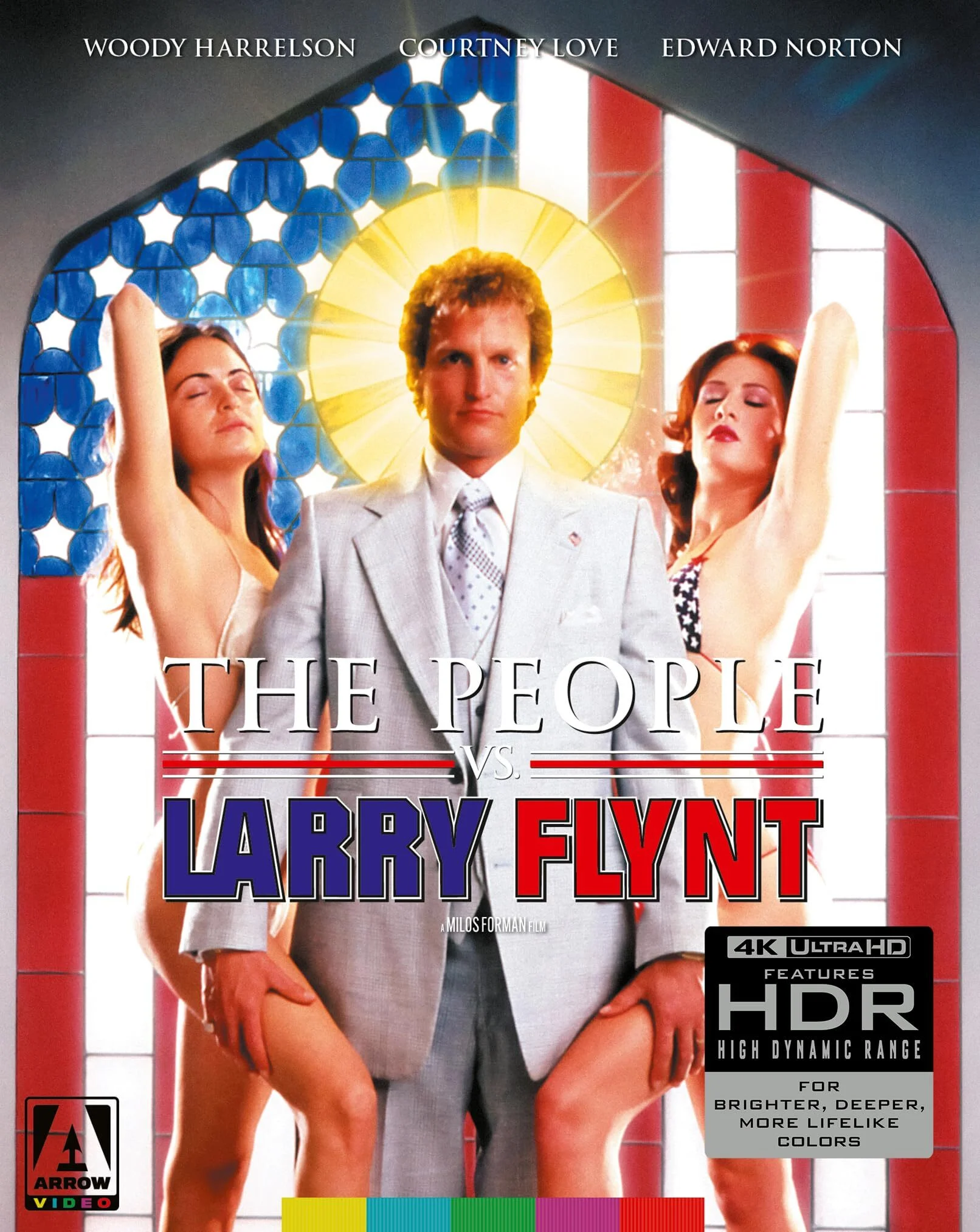
The People vs. Larry Flynt 4K 1996 Ultra HD 2160p
 Like
Like Don't Like
Larry Flint was a hero of the 1970s—an era of the sexual revolution, drugs, and cultural upheavals. He realized that people needed something more than TV and weekend picnics. They needed entertainment. With his remarkable intuition, he decided to take a step that would forever change his life and divide society into those who were for him and those who were against him. He began publishing a porn magazine. But "Hustler" became more than just a magazine. It was a challenge to society. And an offended society decided to punish Larry Flint.
User Review
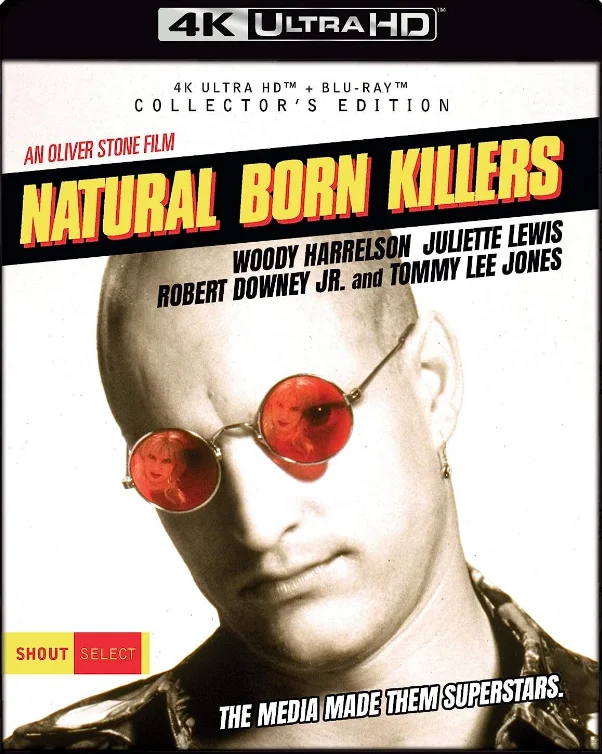
“The People vs. Larry Flynt” is the biggest scandal in Forman’s filmography and one of the most striking counterculture films in the U.S. during the 1990s. Watching it for the first time specifically for this article, I didn’t expect it to fill me with such delight and, at the same time, such sadness. This film, of course, isn’t about the First Amendment to the U.S. Constitution and its defense by lawyers as a national treasure. It’s about a character—a sordid, unpleasant one, yet necessary in any free society to highlight its flaws. And once again, as is often the case with Forman, it’s about the legacy of the counterculture that changed the modern world. The film’s scathing political message was bolstered by Oliver Stone’s involvement as a producer and the casting of Woody Harrelson in the lead role—Harrelson, who had already made a name for himself at the time in Stone’s equally scandalous "Natural Born Killers". "The People v. Larry Flynt" is only partly about the legal battles surrounding "Hustler"; little is said here about pornography, since Flynt’s lawyer—brilliantly portrayed by Norton—was defending not pornography at all, nor even the First Amendment, but a person’s right to live and think as they please, even if everyone else disapproves.
Not since *One Flew Over the Cuckoo’s Nest* has there been such a controversial film in Forman’s filmography, but this time he didn’t win an Oscar—times were different then—though the film was recognized in Berlin, where it was awarded the Golden Bear. There’s probably no film more relevant today: it’s no coincidence that the most powerful and funny scenes are those showing Flint’s disrespect for the court, when he puts on diapers in the colors of the American flag. Of course, something like that would be impossible here. After starting an unsuccessful career in the mid-1970s in the strip club business, Harrelson’s character soon switched to publishing a magazine, losing one court case after another, but it was only after losing almost everything that he finally succeeded in the late 1980s. Larry Flint is a true child of the counterculture, entangled in polygamy, alcoholism, and drug addiction; the film does not exonerate him—Forman’s goal is different: to show how, in a normal society, the rights of an individual standing against the majority are protected.
Democracy is not about protecting the rights of the majority, as people tend to think, but about protecting the rights of the individual. Judging by *The People v. Larry Flint*, democracy often fails, especially when that individual is unpleasant and irritates everyone—Anglo-Saxon white Protestants, the FBI, and the press. After all, Larry Flint destroys himself and even his wife’s life, but that is no reason to denounce and judge him. It was a stroke of luck to cast Flint’s wife, Althea Courtney Love—who herself has been through more than a few court cases in her time—in the lead female role; here, she essentially plays herself—a shrew and a drug addict (though how different she is from her real-life self in *Man on the Moon*). Together with Harrelson, they form a powerful and vibrant duo—even better than the one with Juliette Lewis in *Natural Born Killers* (where the male lead took the lead; here, they’re on equal footing). *The People vs. Larry Flynt*, filmed seven years after the failure of *Valmont*, became Forman’s first film of the 1990s—and one that captures the spirit of that decade far better than even the films of Stone and Tarantino. After all, the 1990s are not considered an era of “new barbarism” and the erasure of previous cultural codes for no reason.
It was a time when the counterculture’s last reserves of strength were running out—having finally breathed a sigh of relief after its battles with neoconservatism in the 1980s—yet it was also a time of deadlock, when the former activists of the 1960s turned, if at all, to academia, but for the most part simply ruined their own lives, disillusioned by the impossibility of realizing their former ideals. Larry Flint and Althea were no exception—by depicting their story without sugarcoating or justifying anything, Forman also spoke about himself, his own victories and defeats in Hollywood, where he had spent most of his life. By the end of his life, he had become completely disillusioned with the values of liberalism and the counterculture (as seen in *The Ghosts of Goya*), but he remained, like his characters, devoted to their core idea until the very end—the right of the individual to “shake up the system” if he considers it unjust.
Info Video
Codec: HEVC / H.265 (89.7 Mb/s)
Resolution: Native 4K (2160p)
HDR: Dolby Vision, HDR10
Aspect ratio: 2.35:1
Original aspect ratio: 2.39:1
Info Audio
#English: DTS-HD Master Audio 5.1
#English: FLAC 2.0
#French: Dolby Digital 5.1
#German: Dolby Digital 5.1
#Italian: Dolby Digital 5.1
#Japanese: Dolby Digital 2.0
#Spanish: Dolby Digital 2.0
Info Subtitles
English SDH (PGS), Arabic (PGS), Bulgarian, Chinese (Mandarin Traditional) (PGS), Czech, Danish (PGS), Dutch (PGS), Finnish (PGS), French (PGS), German (PGS), Hebrew (PGS), Hindi (PGS), Italian (PGS), Japanese (PGS), Norwegian (PGS), Portuguese, Portuguese (Brazilian) (PGS), Spanish (Castilian) (PGS), Spanish (Latin American) (PGS), Swedish (PGS), Thai (PGS), Turkish, Vietnamese.File size: 88.32 GB