




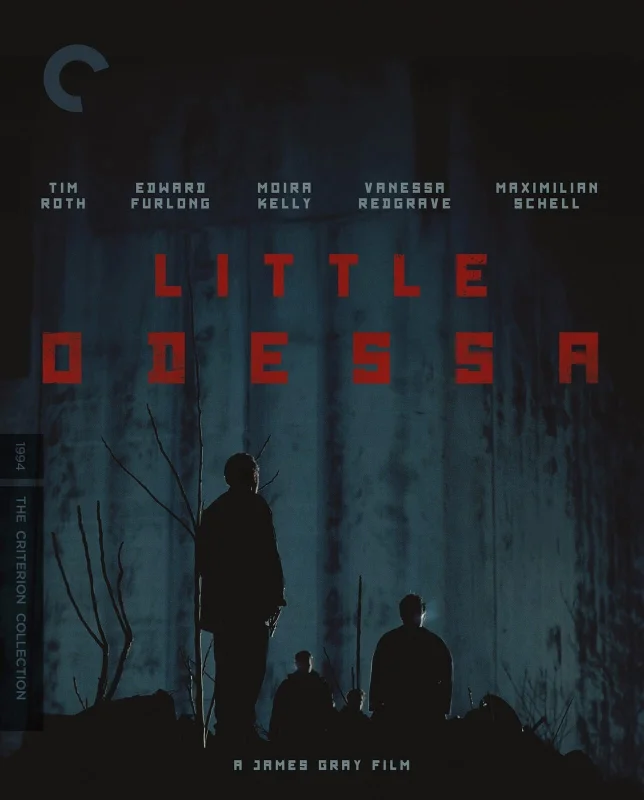
Little Odessa 4K 1994 Ultra HD 2160p
 Like
Like Don't Like
This crime drama is set among immigrants from the former Soviet Union living in a neighborhood called “Little Odessa” in Brooklyn. Professional hitman Joseph Shapiro (Roth) is assigned to “take out” a man in his home neighborhood, where his father (Shell), his dying mother, and his younger brother live. His father has long since disowned his hitman son, knowing full well what he does for a living, but his brother and mother still love him. And even his father cannot completely erase him from his heart. The family reunion ends in tragedy. Yosif is forced to kill the son of a local “boss” who believed him to be dead, since the son had spotted him on the street, and Yosif could under no circumstances allow the deceased’s father to find out—that would be tantamount to death. As a result of the showdown, his younger brother is killed. The film is shot in a style that is not at all American—unostentatious, restrained, yet expressive. The style is even somewhat reminiscent of Babel’s short stories. Natasha Andreychenko, Shell’s real-life wife, swears profusely in the role of his mistress. The film won the Silver Prize and the Best Supporting Actress Award for Vanessa Redgrave at the 1994 Venice International Film Festival.
User Review
James Gray, a graduate of the Southern California School of Cinematic Arts, was already able to demonstrate the key traits of his future film career in his debut film, as well as his own adaptability and ability to cast renowned actors in leading roles. The star-studded cast of *Little Odessa* included Tim Roth, who had already made a name for himself playing criminal roles by that point, and Edward Furlong, who had become a household name after *Judgment Day*. For a low-budget crime drama about Russian Jews in America, the cast is more than impressive, and it’s worth noting that Gray handled working with this ensemble well, resulting in a restrained film in the best traditions of low-budget dramas.
The Russian speech interspersed throughout the English dialogue lends the film a special exotic flair. It’s done in a unique way—and quite well, actually—especially considering that the film’s characters have likely been speaking a foreign language for too long to have acquired such a noticeable accent. And yet, hearing their native language in a foreign film is a pleasure; moreover, the actors handled it skillfully, at times even elevating it to a dramatic level. This, along with the very presence of Brooklyn’s run-down neighborhoods, gives the film a much more European feel—which, in fact, becomes one of director James Gray’s defining traits: his ability to show “another America.”
The film is definitely not bad, but there’s not much that’s good about it either. Perhaps that’s just the reality of life, but the only “heartthrob” in the film is Tim Roth. An uncompromising killer who isn’t without a lively spark and cinematic charm—this kind of role is nothing new for him—but he’s the only character in the film who has achieved anything in life, even though his father insists otherwise; yet this comes across as empty, unsubstantiated grumbling or even moralizing, as if to say, “Killing is wrong.” Edward’s character isn’t averse to shooting either; he’s in awe of his older brother, and he himself is growing into quite the troublemaker: he smokes, acts rudely, and has dropped out of school… One of Gray’s goals in *Little Odessa* was precisely to show the tragedy of such a path, but he succeeded only partially, failing to point the way out of this closed and vicious circle—except for Joseph Shapiro, sitting in the car, who will, of course, survive this tragedy as well.
In addition to the criminal element, the film also depicts a raw, everyday realism—often repulsive, but genuine. The hitman, having returned to his home neighborhood, is less concerned with his line of work than with reconnecting with his family, whose father has long since written him off as dead.
Only his mother, who is dying of a tumor, and his younger brother are still willing to accept him. In fact, given the ending, this creates yet another metaphor for loneliness—or even the loss of the home he returned to, only to lose that small homeland forever. The sad irony of the ending is perhaps one of the film’s best moments, rivaled only by the shootout in the courtyard shortly before.
The level of drama is high, but there is no real tension, and this will be lacking in Gray’s subsequent films as well. Here, he makes a rather amusing attempt to hint at a deeper meaning by referencing Dostoevsky’s *Crime and Punishment* and including church choirs in the background music. However, while these techniques never detract from the film, they seem completely out of place, especially in this context.
Info Video
Codec: HEVC / H.265 (78.3 Mb/s)
Resolution: Native 4K (2160p)
HDR: Dolby Vision, HDR10
Aspect ratio: 2.39:1
Original aspect ratio: 2.39:1
Info Audio
#English: FLAC 2.0
#English: DTS-HD Master Audio 5.1
#French: DTS-HD Master Audio 5.1
Info Subtitles
English SDH (PGS), Danish, French (Metropolitan) (PGS), Swedish.File size: 57.70 GB