







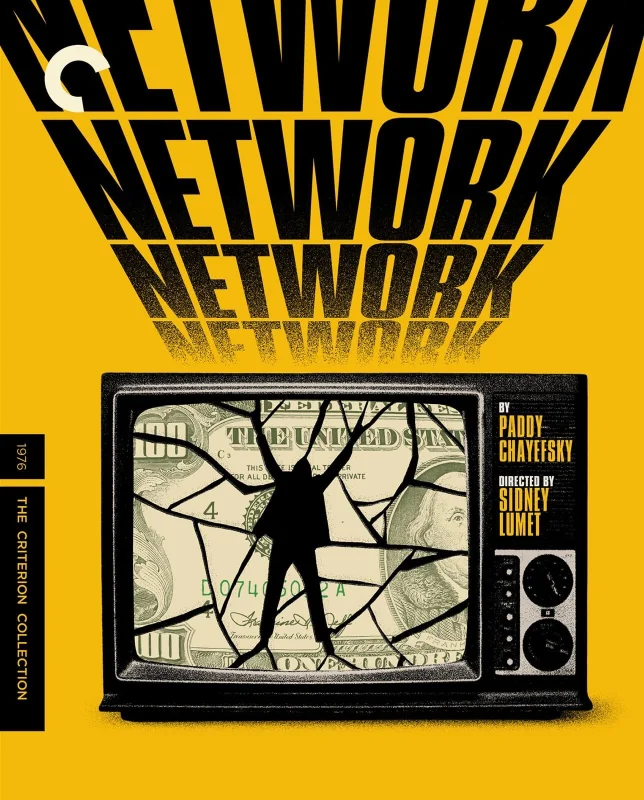
Network 4K 1976 Ultra HD 2160p
 Like
Like Don't Like
Howard Beale, the regular star of UBS-TV news, got into trouble: he had a nervous breakdown during a live broadcast. Ironically, his public outburst boosted his already fabulous ratings, much to the surprise and delight of his bosses at UBS. As a result, having become famous as the “mad prophet of live television,” he soon became a pawn for his ruthless bosses, who milked his crazy antics for all they were worth at every opportunity. Of course, when the “prophet” became useless, something had to be done about him urgently, preferably in front of the camera and a full audience.
User Review
He is the head of the news department, but his time is running out: the UBS media corporation is changing rapidly, and this old-school man refuses to join the mad race downhill, where colleagues compete to see who can reach the bottom faster. He can't bear to watch his friend turn into a madman, squeezing the last drops of juice from his broken soul. He's from a generation when the grass was greener and the screens were bluer. Now they're flooded with red and brown, and viewers are choking on it but demanding more. He is too old for this shit, and yet he is attracted to her — the person who embodies the new prime time: cynical, scandalous, fierce. He enters this raging river, washing away everything in its path, deeply unhappy inside, unable to bring joy to himself or his neighbor.
She is a careerist with masculine energy who came to the news department and literally survived there for a week. She clings to every opportunity with a desperate grip, as if each time were her last chance to succeed. Unprincipled and devoid of pure emotions, she feeds on those of others, generating passion and ambition in the process. Life for her is just an inappropriate addition to her career; she cares only about programs, ratings, numbers, and percentages. Even in bed, she talks about work like a woman possessed, getting herself excited with dreams of future sensations and climaxing from the anticipation. She is indifferent to life's values, but she knows that she can make money by trampling on them. Max and Diana, an undisguised allusion to the past and future of the small screen, whirl around in a farewell dance before scattering in different directions forever.
Their name is Legion, they come home after a hard day's work and want to see someone else having an even harder time. Each of them has a pile of problems that cannot simply be shrugged off and forgotten. They are deeply unhappy and want to be entertained and intimidated—that way, their obsessive thoughts about their troubles will go away for a while. And then, in the next news broadcast, the desperate announcer Howard Beale will burst into an angry tirade, promising to end his life in a week in front of millions of viewers. He will commit professional suicide in the same studio in a couple of days, but they will not allow him to commit physical suicide—they will vote for Howard with their ratings, and the channel owners will have no choice. He will rant and rave on his own show, speaking with fury in his eyes about what is bothering him: they will feel a genuine unity with him, with each other, with this despicable box that offers to throw open the window and send everything to hell.
Sidney Lumet's film is a grotesque on the verge of absurdity, which is reinforced by the abundance of swearing and expressive language in the characters' speeches. Almost everyone sooner or later resorts to shouting, and only in this state are they honest with themselves. Only Max remains calm even in the most difficult moments: he does not need to lose control to reveal his sincerity. The crowning glory of these eloquent escapades is the media mogul's sermon on the new gospel, demonically booming in the dim light of the spacious conference room. Despite the shock value of its content, the film's form meets the standards of the 1970s: unhurried narration and attention to characters, a multi-layered plot that flourishes not in action but in dialogues and monologues. This measured pace and a certain asceticism are reflected in the setting: most of the scenes take place in the cramped offices and workrooms of UBS — ordinary and completely faceless, which, together with the absence of background music, protects the film from speculative cinematography. This rejection of everything superficial and insignificant emphasizes the characters and their actions. Even the frequent appearance of the main characters' romantic intrigue is offset by the absolute absence of melodrama and attention to the very essence of their relationship.
Paddy Chayefsky's screenplay is a harsh satire on the verge of foul play, where he paints a hyperbolic reality with bold strokes, in which the box becomes a refuge for murderers and false prophets, and the viewer, once again satiated, switches to another channel where the blood is thicker and the scandals are more scandalous. UBS cynically exploits other people's obsessions and, without a shred of remorse, dumps tons of waste material. He puts the cry of the soul on a conveyor belt, devaluing all previous sermons with each new one, killing the sad sanity of the original speech with the aggressive frenzy of a new sectarianism. In the struggle for ratings and audience, neither law nor morality can stop it: it will finance terrorists so that they share exclusive material about new murders and robberies on a weekly basis. Why is this scenario hardly shocking today? He is now 40 years old, and federal and commercial channels are merciless to viewers, employees, and themselves, confidently stepping into the abyss of absurdity that once seemed incredible. It is all the more frightening when grotesque fiction becomes a prophetic parable. And everything would have been fine if, on July 15, 1974, the desperate host Christine Chubbuck had not shot herself on live television.
Info Video
Codec: HEVC / H.265 (87.2 Mb/s)
Resolution: Native 4K (2160p)
HDR: Dolby Vision, HDR10
Aspect ratio: 1.85:1
Original aspect ratio: 1.85:1
Info Audio
#English: Dolby Digital 1.0
#English: FLAC 1.0
#English: FLAC 1.0
#English: Dolby Digital 1.0 (Commentary by director Sidney Lumet)
Info Subtitles
English SDH, Arabic, Danish, Dutch, Filipino, Finnish, French (Canadian), French (Metropolitan), German SDH, Indonesian, Italian, Norwegian, Polish, Portuguese (Brazilian), Portuguese (European), Spanish (Castilian), Spanish (Latin American), Swedish, Thai, Turkish.File size: 75.44 GB