



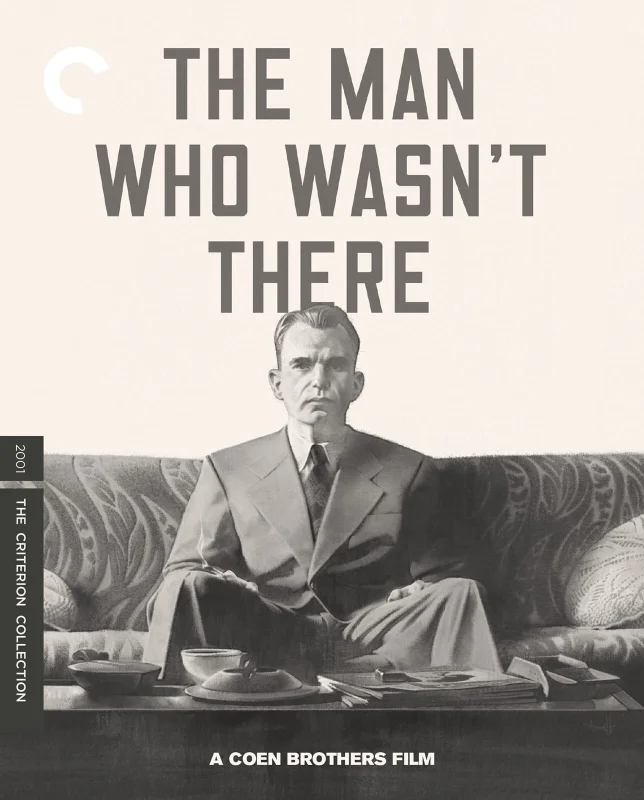
The Man Who Wasn't There 4K 2001 Ultra HD 2160p
 Like
Like Don't Like
The Man Who Wasn't There is a new film by Joel and Ethan Coen. It is set in 1949, and the main character is Ed Crane, a barber in a small town in Northern California. He is dissatisfied with his life. His wife's infidelity gives him an opportunity to engage in blackmail. He believes this will help him change his life. However, Ed's plan is exposed, revealing dark secrets, and a murder takes place...
User Review
For example, a man goes to feed a tiger, but the animal prefers its owner. Previously, the man was prohibited from keeping a tiger, as this is naturally dangerous, but he went to court and had the ban lifted, refusing to back down in the face of obstacles. Another kills his wife's boss, for which she will be blamed, while he himself will be convicted of murdering a salesman whom his late boss had previously drowned in a lake. It's laughable. A third man endlessly drags a huge stone up a hill; there is no end to his torment, and even the gods have forgotten why he is suffering.
What do these stories have in common? Or let's rephrase the question: is absurdity
a universal phenomenon?
It is commonly believed that The Man Who Wasn't There was deliberately released in black and white to parody film noir. This is entirely possible. Nevertheless, without diminishing the Coen brothers' penchant for mockery, one should not indiscriminately criticize their work, especially since the film is not so much black and white as it is color with the color washed out, as if the film had been doused with a bucket of water. In principle, black-and-white cinema is a reflection of reality in which reality is presented in a much smaller volume than is implied, that is, due to the mere pictorial stinginess of the black-and-white frame, it contains much less than it means. The same thing happened when Albert Camus's novel The Stranger was published: critics drew attention to the language in which the novel was written: its sparseness and soullessness, its simplicity and abruptness of expression; the style was dubbed “zero degree writing.” For Camus, this approach to the text is conceptual, because this technique established a pandemic of indifference—the hero's indifference to the world, the world's indifference to him, and his indifference to himself. It is difficult to say whether the Coens intended such parallels, but there is a similarity between the works—commonplaces—and “zero degree”—the first. The detachment, apathy, and deliberate “black and white” nature of the film are the same as Camus's soulless text. The similarity of names and characters; the indifferent, silent Ed Crane is as out of place in provincial America as Meursault is in the French colony. Note: the main character's surname means “crane” in English, i.e., something that lifts heavy loads.
Both are tried for murder, but neither killed out of hatred or calculation, but only to free themselves from the need to do so. In both trials, the subject of the trial is replaced: Crane is tried for someone else's murder, Meursault for not crying at his mother's funeral. In both cases, the personality of the criminal is distorted.
The prosecutor presents Mersault as a monster—a villain destructive to society with a bottomless abyss in his heart. Similarly, but in reverse, the lawyer presents Crain as a simple modern man, just like everyone else, which he is, in essence, not at all. Neither defendant is allowed to speak; the trial proceeds as if without their participation. Both are squeezed out of life.
These are the external attributes of the film and the characteristics of its style. The spring is the efforts of the aging Crane, caught in a karmic loop, to break out of the vicious circle. He makes two such attempts: the first is traditional, naively believing that tickets to a new life are necessarily treasury bonds, and that this effort will lead him to the throne—even if it is electric (the sarcastic smile of fate and horoscopes: Crane has been cutting others' hair all his life, and in the end, they cut his). The second attempt—the daughter of an acquaintance, the last bastion of beauty and pure meaning—suffered a fiasco of no less caliber: the cutie turned out to be mediocre and a banal female. And this project fell through. Purity does not exist; one can only wander through the dunes for a while. The person who was not there, in this case, is not the name of an individual, but of a species. Ed Crane's line in the film is not the only absurdity in the parade; there are others, though not as pronounced.
If you think about it, the lion's share of human humor revolves around sex and death, even though sex itself is a standard of decay, marking the passing of the baton. Perhaps this is no coincidence. Perhaps this is a defense mechanism, a gift from nature, our ability to compensate for one very unpleasant piece of knowledge. Despite all their playfulness and visionary nature, the Coens are pessimists, which, incidentally, was confirmed by their latest work. But instead of gloomy whining, they prefer to express their thoughts with humor. And they are right to do so.
In general, this film is close to being a masterpiece, I insist.
Info Video
Codec: HEVC / H.265 (90.2 Mb/s)
Resolution: Native 4K (2160p)
HDR: Dolby Vision, HDR10
Aspect ratio: 1.85:1
Original aspect ratio: 1.85:1
Info Audio
#English: DTS-HD Master Audio 5.0 (48kHz, 24-bit)
#English: Dolby Digital 2.0 (Commentary by co-directors/co-writers/co-producers Joel and Ethan Coen, and actor Billy Bob Thornton)
Info Subtitles
English SDH, Chinese (Simplified), Chinese (Traditional), Danish, Dutch, Finnish, French (Metropolitan), Indonesian, Malay, Norwegian, Portuguese (Brazilian), Spanish (Castilian), Spanish (Latin American), Swedish, Thai, Vietnamese.File size: 76.64 GB