



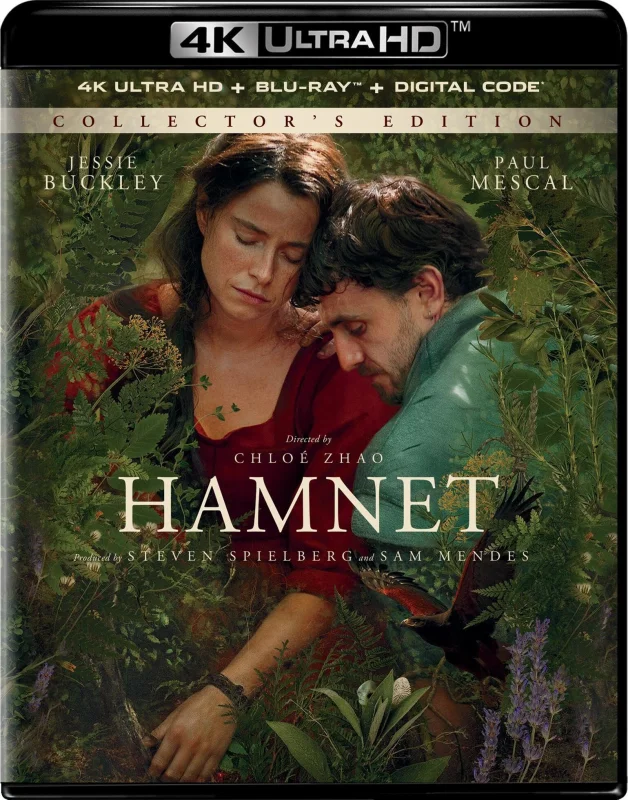
Hamnet 4K 2025 Ultra HD 2160p
 Like
Like Don't Like
A fictional story about William Shakespeare and his wife Agnes. After the death of their eleven-year-old son Hamnet, the couple go through the grieving process in different ways: Shakespeare writes the play Hamlet, while Agnes chooses her own path.
User Review
The film Hamnet, based on the novel of the same name by Maggie O'Farrell, tells the story of William Shakespeare's life and the tragedy that is believed to have been the inspiration for the greatest play of his life. In essence, this film is not about the origins of a great text or about genius as such. It is a film about what exists before art—about pain that cannot yet be put into words.
The death of Shakespeare's son is a historical fact, as is the context of the era: bubonic plague, high infant mortality, a reality in which it was considered normal for half of all children not to live to see their tenth birthday. In this sense, Shakespeare's family was “lucky” — tragedy was not an exception, but part of the times. But Zhao fundamentally rejects historical distance. For her, loss is not a statistic or a backdrop, but a personal, physical, irreversible rupture.
Hamnet is a story of the love between a man and a woman, the development of their relationship. Agnes is completely immaterial. She does not value gifts or symbols of wealth. She already has a glove for falcons. The house does not inspire enthusiasm. She is not interested in what can be given, but in what can be shared. And William finds his way to her not through things, but through words, through a higher meaning, which, contrary to her peasant origins, is not at all foreign to her.
From the very first minutes, the film declares its symbolic nature. At the beginning, William tells Agnes the ancient Greek myth of Orpheus and Eurydice — the story of an attempt to bring back his beloved from the realm of the dead and Hades' fateful condition: not to look back. Orpheus cannot resist, looks back — and loses her forever. This myth becomes the key to the entire film.
The first reference is the scene at the altar. Agnes follows William and asks him to turn around and look at her. He turns around, as if warning the viewer that marriage to him could be Agnes's descent into hell. Almost the entire film confirms this premonition. William is absent—physically and emotionally. He does not participate in family life, he is not there when his son dies, he seems not to hear and does not want to hear his wife. Unlike the hawks, which Agnes knows how to tame, he is blind to her and her feelings.
The second reference to the myth occurs during the play, when Agnes asks William to look at her from the stage. He turns around again — but now this gaze does not mean doom, but recognition. This is the moment when they finally see each other.
William does not express sympathy directly; he does something else — he creates a play in which the entire audience and future generations for centuries to come will experience this loss together with her. He immortalizes her grief and thereby acknowledges it. And it is this, not words, that brings Agnes relief.
The film's ending is a rare example of genuine catharsis without sentimentality. In the final scene, Agnes is finally able to let her son go into the “dark forest.” And at that moment, it becomes clear: art heals, but not on its own, but when filtered through the prism of personal experience. In Gamnet, mutual understanding is equated with art as the highest form of human existence.
The impression of the film can be deceptive. Almost until the very end, it seems too slow, too detached, almost impenetrable. Ninety percent of the time, the viewer may not understand why this film has won awards. But the ending shifts the perspective, and the film reveals itself in retrospect — like pain that you only understand when it finally takes shape.
In the end, Hamnet is not a film about Shakespeare. It is a film about how art is born not from genius, but from the ability to see another person. And perhaps that is why it is a great film.
Info Video
Codec: HEVC / H.265 (78.6 Mb/s)
Resolution: Native 4K (2160p)
HDR: Dolby Vision, HDR10+
Aspect ratio: 1.78:1
Original aspect ratio: 1.78:1
Info Audio
#English: Dolby TrueHD with Dolby Atmos 7.1
#English: Dolby Digital 5.1
#Spanish (Latino): Dolby Digital 5.1
#French: Dolby Digital 5.1
Info Subtitles
English SDH, French (Canadian), Malay, Portuguese (Brazilian), Spanish (Latin American).File size: 72.88 GB