


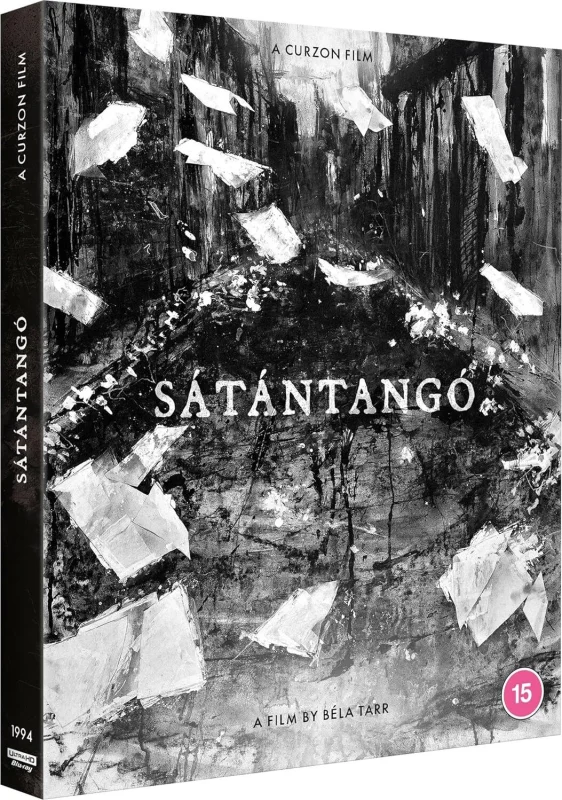
Satantango 4K 1994 Ultra HD 2160p
 Like
Like Don't Like
“This isn’t so much a movie as it is a place you’re invited to visit,” the director clarified in an interview, encouraging viewers to relax and spend some time among the characters of Krasnokhorkaia. To make it easier for the audience to immerse themselves in the life of this tormented commune, existing in an atmosphere of endless rain, cruelty, and drunkenness, Tarr depicts village life in "Satantango" with meticulous, excessive detail. The wandering camera captures one drawn-out ten-minute shot after another, forcing the audience to either scrutinize long-familiar and otherwise unremarkable objects with heightened attention or to watch someone’s receding back for a long time with detached indifference. The film’s events are reduced to the level of wallowing in the mud, repeatedly bringing to mind the Marx-Chekhov maxim about the “idiocy of village life.” All of this, multiplied by the drone of an accordion breaking through the sound of the rain, lulls the viewer into a trance, drawing them into a new level of detachment while at the same time making them feel like one of the locals.
User Review
There are three things you can watch endlessly: a fire burning, water flowing... and the hypnotic scenes in Béla Tarr’s films. The metaphysics that arises from simple contemplation is simply overwhelming, and through the monotony of the long takes, life itself shines through. Few have managed to capture an almost documentary-like reality on the screen, but this brilliant Hungarian director succeeded.
The last cinematic classic among the greatest filmmakers of the 20th century—alongside Dreyer, Bergman, Bresson, Antonioni, and Tarkovsky—he speaks the same language of silent signs and subconscious counterpoints as his outstanding European predecessors. People either love him (if they feel and understand his work) or hate him (if they watch with a blurred gaze). And the seven-hour *Satantango* is undoubtedly the last great film of cinema’s first century.
Interestingly, "Satantango" is the very essence of 1990s cinema, if not the definitive film of that decade. One can find parallels in it with Kusturica, Kaurismäki, Jarmusch, and even (oh, movie gods!) Quentin Tarantino; the Hungarian director’s film is structured with the same mosaic-like, non-linear sequence of episodes as *Pulp Fiction*, released in the same year, 1994. At the same time, Tarr follows the national tradition of Hungarian cinema, and the unhurried pace of the “floating camera” is reminiscent of the “cinematic ballets” of his compatriot Miklós Jancsó.
A simple story about a farming commune and its annual harvest, where everyone tries to deceive everyone else—and even themselves—evolves toward the end into a biblical parable with elements of magical realism and existential poetry. At its center is the “fallen angel” Jeremias, the last hope of the village’s inhabitants, who have been “abandoned by God.” Dirt, dreariness, drunkenness, suicide, constant rain, allusions to the collapse of the socialist bloc and the utopia of the “world of capital” are tempered by an unhealthy dose of black humor and the rousing accordion theme “Galicia” composed by Mihai Viga (in the film, the legend of Hungary’s underground rock scene played the role of Jeremias).
In the era of the music-video mindset, Béla Tarr goes his own way, accused by many hostile critics of lacking talent per se. After filming "The Turin Horse" in 2011, he announced his retirement from filmmaking—and he was probably right to do so.
There’s no point in throwing pearls before swine—that is, before an audience wearing 3-D glasses—because the reality that the Hungarian director created, one you could practically “touch,” is of little interest to almost anyone.
It’s generally believed that it’s impossible to adapt Márquez’s novel "One Hundred Years of Solitude" for the screen, but after watching "Satantango", you realize it can be done; the ending of Tarra’s film (even though it’s based on a different work), with its subtle, unseen rhymes, resonates with the incredible conclusion of the novel by this classic of Latin American literature.
Info Video
Codec: HEVC / H.265 (78.5 Mb/s)
Resolution: Native 4K (2160p)
Aspect ratio: 1.66:1
Original aspect ratio: 1.66:1
Info Audio
#Hungarian: FLAC 1.0
Info Subtitles
English SDH (PGS), Dutch, Japanese (PGS), Spanish (Castilian), French (PGS).File size: 243.18 GB