







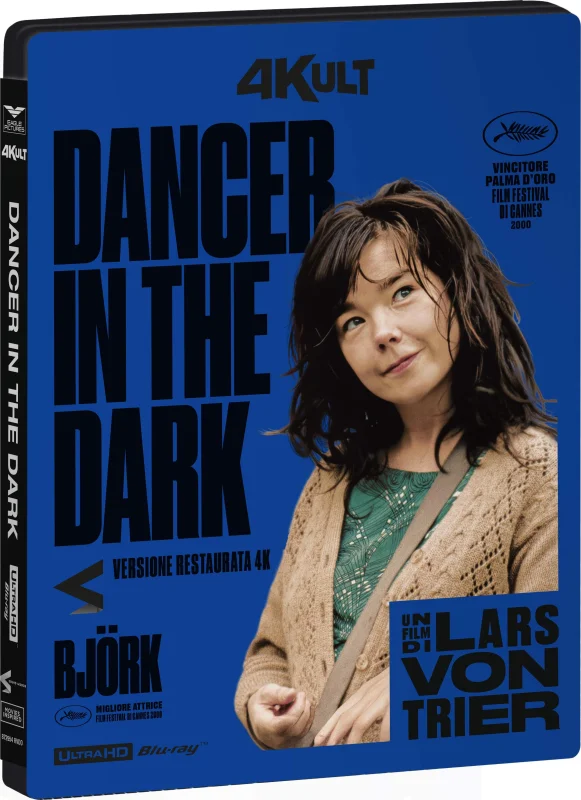
Dancer in the Dark 4K 2000 Ultra HD 2160p
 Like
Like Don't Like
The musical is set in America in the 1960s. Selma, an immigrant and single mother, works at a small factory. The main character is nearly blind, and her vision gets worse every day. She earns next to nothing at her job, and her son is also at risk of going blind. To save up for his surgery, she denies herself everything. But one day, she is faced with a choice between saving her own life and her child’s health.
User Review
This is how the “Dogma 95” Manifesto, written by Lars von Trier and Thomas Vinterberg, ends. While working on a project, Lars von Trier came to the conclusion that the plot is more important than technique, and that style is less important to the average viewer. For the average viewer, the plot and characters are what matter, so he and Vinterberg wrote the manifesto and drew up 10 rules—10 rules for making films under the “Dogma 95” program. In 1997, von Trier directed *The Idiots* in accordance with the principles of his manifesto, but a little later, in 2000, *Dancer in the Dark* was released, which departed from Dogma 95; however, von Trier remained convinced that plot > technique and style.
*Dancer in the Dark* compels you to empathize with the main character from the very first seconds, and then transforms that empathy into pity, regret, and sorrow. Have you seen *The Green Mile*? Did you cry at the end? Here, you’ll have to cry and empathize many times more!
The film is heartbreaking, thanks to the magnificent performance by Björk (the Icelandic singer and actress) and Trier’s excellent screenplay, which sometimes offers—but more often destroys—any hope for a happy ending.
Her childlike appearance, loyalty, and the mindset of an immigrant from Czechoslovakia are captivating and make you feel for her—just as she does for her son.
Technique and Style:
As I’ve already said, Trier doesn’t stray from his vision at all, so he pays minimal attention to technique and style. And in a way… is that even commendable? That doesn’t change the fact that the film is awful and was a pain to watch. Handheld camera work, rapid pans, somewhat poor color grading, and excessive grain—these are a pain to the eyes of aesthetes. But let’s not forget that cinema is about manipulating the viewer’s emotions. A typical feature film is created with the goal of evoking emotions in you as you watch. And it’s precisely the music, the plot, the technique, and the style that are meant to play with the viewer’s emotions and make them feel exactly what’s needed. What does Trier do? He removes two elements from this formula. Yes, he doesn’t abandon music, but he does abandon technique and style in favor of the plot. This allows the viewer to be freer in their emotions and to fully enjoy and reflect on the plot.
Lars von Trier is a true literary classic who also knows how to make films and isn’t afraid to experiment. He’s made a film that breaks anyone’s heart and shatters—leaving no fragments—the heart of any mother.
Info Video
Codec: HEVC / H.265 (49.9 Mb/s)
Resolution: Upscaled 4K (2160p)
Aspect ratio: 2.35:1
Original aspect ratio: 2.39:1
Info Audio
#English: DTS-HD Master Audio 5.1
#Italian: DTS-HD Master Audio 5.1
Info Subtitles
Italian (PGS).File size: 55.63 GB