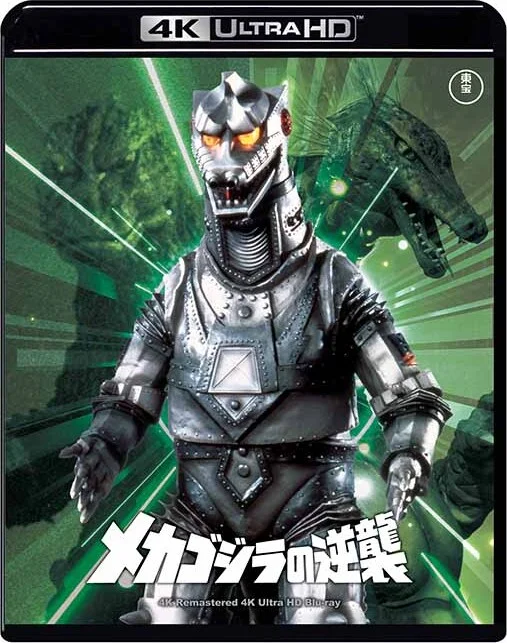




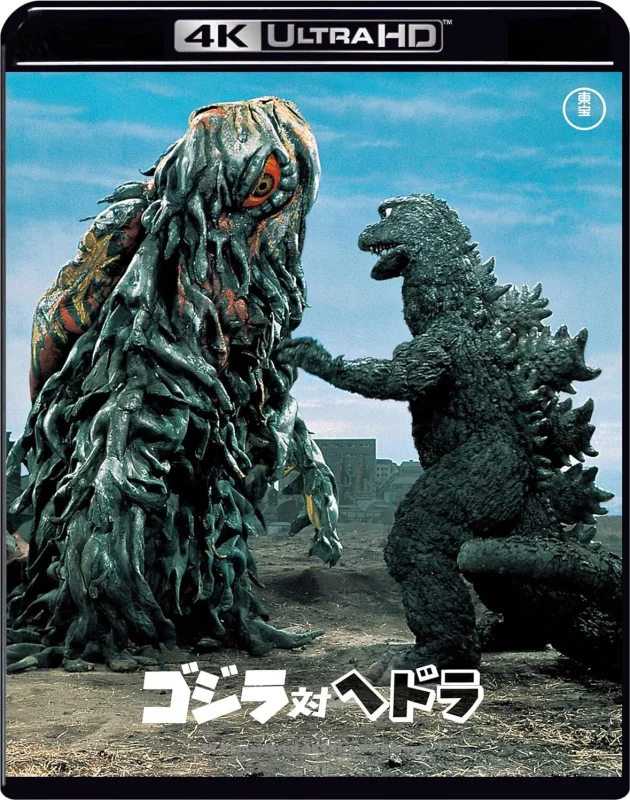
Godzilla vs. Hedorah 4K 1971 Ultra HD 2160p
 Like
Like Don't Like
Coming to Earth on a meteorite that falls to Earth, a microscopic alien life form later named Hedorah feeds on Earth's pollution and eventually grows into a gigantic, ever-evolving, poisonous smog-spewing and acidic sludge-secreting monster. Godzilla, Earth's defender, senses the threat and meets ''the Smog Monster'' head-on in a literal battle for Earth's survival.
User Review
Apart from the first two films, Godzilla and Godzilla Strikes Again, this is the only film from the Showa era that can be considered a full-fledged horror film. Starting with King Kong vs. Godzilla, the franchise about the mutated lizard began to slide into outright self-parody, which was received rather coolly not only by fans, but even by the most undemanding viewers. The previous film in the series, the parodic Godzilla's Revenge, written by Ishiro Honda, was a box office flop, so it was decided to make the new film more serious and reduce the level of comedy (although not remove it entirely). The film opens with a peculiar parody of James Bond, albeit not as sparkling as, say, the sixth Friday the 13th, but nevertheless setting the necessary tone. This time, the director's chair, as well as the screenplay, was entrusted to a student of Akira Kurosawa himself, a certain Yoshimitsu Banno, who had previously proven himself as an assistant director on a huge number of the master's films. Now, the bosses at Toho Studios have decided to give the new director a chance to practice his craft by creating the next, twelfth installment of the respectable franchise. Given carte blanche, Banno apparently decided to be original and, instead of another return of Godzilla fighting yet another benevolent monster-protector, he pitted him against absolute evil, not as a friend of humanity, but as a defender of the planet's ecology.
The film turned out to be quite pleasant from a visual point of view. Banno has excellent visual skills as a director; it's a pity that after this debut, he only made one more film and did not return to directing. The cinematography is beautiful, and the lighting and tones of the film are excellent. Every frame of this Godzilla is shot competently and thoughtfully. It is immediately apparent that working with Kurosawa taught the director a thing or two. What is somewhat annoying is the completely unbalanced editing. The transitions between scenes are unnecessarily abrupt and rushed. It is as if the editor was rushing to a fire. We see a scientist with his aqualung descending to the bottom of the ocean, where he observes the fluttering Hedora, but then, lo and behold, the same scientist is already lying in bed with his face bandaged. Neither the monster's attack on the professor nor his subsequent escape are shown at all.
Another problem is that the creators themselves seem unsure of what genre they want to present to the viewer. On the one hand, everything here is very serious and gloomy. People rot alive, vile acid slime destroys entire city districts, naturalistically killing all living things. Hedora's methods of dealing with hommo sapiens are quite reminiscent of the killings in Chuck Russell's film The Drop, and it is obvious that this is where Russell got the idea, which was later used by Carpenter in his The Thing, as well as by Dean Koontz in his Phantoms — in particular, the ability of one huge creature to split into several smaller ones. And David Cronenberg was certainly inspired by something from here when working on his early films.
It would seem that what could prevent this from being an absolute masterpiece of the genre? I would say that the film was filled with extremely absurd humor. In particular, this applies to the behavior of both monsters, especially Godzilla. The scenes in which the lord of nuclear energy challenges the alien mutant to a fight look deliberately ridiculous and try to squeeze forced laughter out of the viewer. And what about Godzilla's flight with the help of a nuclear beam! Hedorah himself, again, came out too comical, although according to the plot, he should scare us. But it's impossible not to laugh at this funny, big-eyed tadpole, even when he turns the unfortunate inhabitants of Japan into disfigured pieces of meat. This is largely due to his frankly idiotic, ball-shaped eyes, reminiscent of anime characters. If the creators had made the monster eyeless, or depicted his eyes differently, it would have turned out much better. In the original concept, the monster's eyes were two small brightly burning lights, like the demon from the movie “The Fortress,” but then for some reason this idea was replaced with funny, kind eyes.
Another problem is the very strange musical numbers inserted between several scenes. Good Lord, Comrade Banno, you're not shooting an Indian melodrama! I understand the authors' desire to diversify the action, but why turn it into such an obvious farce? Wasn't the previous poor film enough? The final battle between the monsters is quite well done for its time. It doesn't descend into insanity, as in the case of the earlier battle with King Kong, but it falls a little short in technical terms. Hedora's basic form turned out to be completely incomprehensible. Couldn't the designers at least cover it with nasty slime, like the smaller creatures?
However, the dynamics and camera work keep us entertained, and the climax is not drawn out and flies by quickly (just like the rest of the film). In general, the film has a rather interesting subtext: we see two supernatural monsters, created by human experiments, fighting each other. But if Godzilla is a product of nuclear weapons, then Hedora is a product of chemical pollution. So it turns out that the authors set out to show which weapon is stronger—nuclear or chemical. I think it would be disrespectful to reveal the outcome of the battle.
Info Video
Codec: HEVC / H.265 (95.4 Mb/s)
Resolution: Native 4K (2160p)
Aspect ratio: 2.35:1
Original aspect ratio: 2.35:1
Info Audio
#Japanese: FLAC 1.0
#Japanese: DTS-HD Master Audio 5.1
#English: FLAC 1.0
#English: FLAC 1.0
Info Subtitles
English, French (Metropolitan), Japanese SDH.File size: 60.29 GB