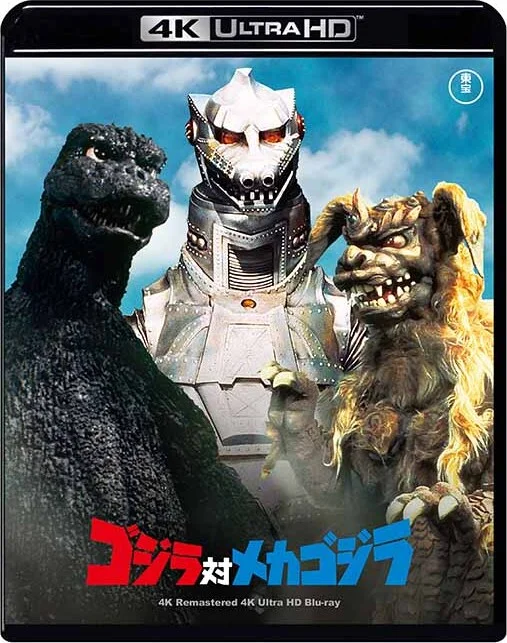
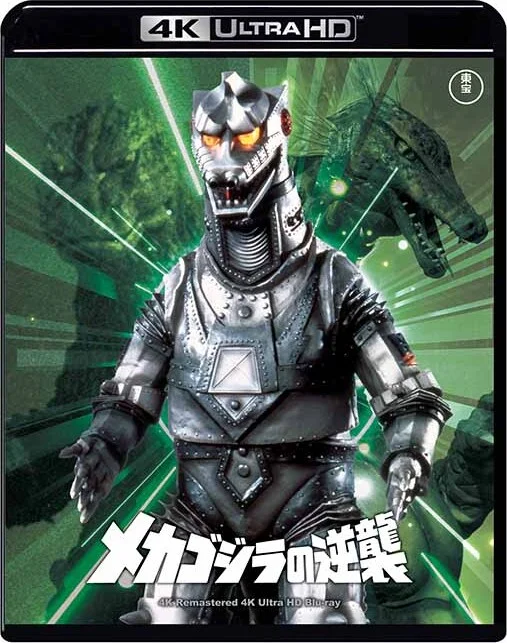
Terror of Mechagodzilla 4K 1975 Ultra HD 2160p
 Like
Like Don't Like
A submarine expedition to salvage the remains of Mechagodzilla is thwarted by a massive dinosaur named Titanosaurus. Biologist Akira Ichinose is brought in by INTERPOL as an investigation is launched. Ichinose's inquiry leads to him to meet Katsura Mafune and uncover the work of her seemingly late father, Dr. Mafune, a brilliant scientist shunned by the scientific community. Dr. Mafune is revealed to be alive and aligned with the Black Hole Aliens, who seek to unleash a reconstructed Mechagodzilla 2 along with Titanosaurus on Tokyo and defeat Godzilla. Ichinose heads off to save Katsura before she loses her humanity to the monsters she controls against Godzilla.
User Review
A month ago, last year, on a fine summer day in July, I watched the first Godzilla movie. Now it's mid-June, almost a year has passed since that day, but my view of Godzilla has changed dramatically. I didn't know then that it was worth stopping. I didn't know what awaited me in the next 28 films, which is how many I watched during that time. There were good moments, such as Godzilla Strikes Again, Mothra, and the first Frankenstein, but there was also a stinking cesspool hiding under many names: Goras, Dogora, Atoragon, Godzilla vs. Gigan. But for the most part, they were mediocre films. Watchable, but still better not to watch them. That's how I remember the Showa era. It was the most assembly line-like assembly line I've ever seen in my life, and now I associate the name “Toho” in the context of kaiju movies with terms such as “creative impotence” and “businessmen making money out of thin air without even breaking a sweat.” What am I getting at? Well, it was Terror of Mechagodzilla that ended the Showa era, as it brought in record low box office receipts (people finally stopped going to see it), causing the company to abandon the franchise for a good nine years.
It is quite symbolic that this particular film ended the Showa era, because it encapsulates many of its characteristics. For example, the structure of the plot. Funding was apparently still rapidly declining, and budgets were not being allocated, so we have the typical “hour of trash, half an hour of kaiju” scheme typical of most Showa kaiju films.
In all seriousness, the first hour is almost devoid of monsters. The sleeping Mecha appears here and there, then we see two minutes of the Titanosaurus, and closer to the 40-minute mark, they splurge on a five-minute demonstration of its power. Needless to say, Godzilla first appears at the 48-minute mark of the hour-and-twenty-minute film, and his robot clone comes out of hibernation later than everyone else, somewhere around an hour in. And this is despite the fact that, let me remind you, the film is called “Terror of Mechagodzilla,” which means that it would be fine if Godzilla or Titanosaurus were in the title, but the monster after whom the film is named appears the least! Logic: “Toho” level.
By the way, the film should have been called “The Terror of the Titanosaur,” because the latter is the most prominent here. Yes, this is another new monster, a giant shrimp that screams coolly and destroys buildings. Not a bad little monster, but nothing special.
The battle between the monsters itself, as last time, was a success. Godzilla knows how to pack a punch, which is why Titanosaurus and Mecha are really perceived as a threat.
Well, how could Mecha not be perceived as a threat — he's brilliant (literally and figuratively)! As always, he flies, shoots rockets, shoots beams, looks gorgeous, and at the same time gives his competitors a good beating. But Godzilla, in his suit from the previous installment, is no slouch either, but he still can't do without human help, because this time he's alone, and there are two of them, especially since one of them is Mecha.
By the way, remember how I said that this film is somewhat reflective of the entire era? Well, Ishiro Honda, who directed most of the Shōwa kaijū films, returned to the director's chair this time. This time, he was given a decent break, about five films, or five years. That's probably why he tried so hard and delivered a pretty good production, which sometimes even shines with some directorial tricks. However, it's still sad when, from time to time, you can clearly see the cables above the flying kaiju — apparently, they should have stuck to the hackneyed traditions.
By the way, I mentioned Honda for a reason, because with him come back the serious shits that are typical for him and most of Showa cinema. Now is the time to move on to the first hour of garbage, which is called the human line. And it's... good here. No kidding. Yes, there are more aliens, all the characters are cardboard cutouts once again, and there is no meaning to what is happening, except to stretch out the running time, because otherwise the credo does not allow it. However, most of the characters are memorable while watching, even if they fade away afterwards, and that's already a huge achievement. In addition, the theme of human interaction with cyborgs is raised here for the first time, which has never been done before. And they even brought some action here. Human action is not on par with monster action, but it still keeps you from getting bored. In the end, you don't get tired, so you reach the monster stage safe and sound, ready to appreciate it for what it is. Gaigan had exactly the same plot structure, but Gaigan fell flat on its face in a puddle of sewage, while this one didn't — it pulled it off.
So, what were the features of Showa here? The “hour of trash, half an hour of monsters” formula, cardboard characters, serious shields, good monster battles, Ishiro Honda, a pretentious soundtrack, as well as raw, empty, implausible dialogues.
And now, the kaiju conveyor belt is entering a new era. You know, I'm not even hoping for quality. I don't think it will be there either. I just hope that it will be something different. Just give me something new, please, it doesn't even have to be good, just new. Otherwise, I'm tired of writing the same type of reviews every time.
Info Video
Codec: HEVC / H.265 (92.5 Mb/s)
Resolution: Native 4K (2160p)
Original aspect ratio: 2.39:1
Info Audio
#Japanese: DTS-HD Master Audio 5.1
#Japanese: FLAC 2.0
Info Subtitles
English, German, Japanese.File size: 56.47 GB