



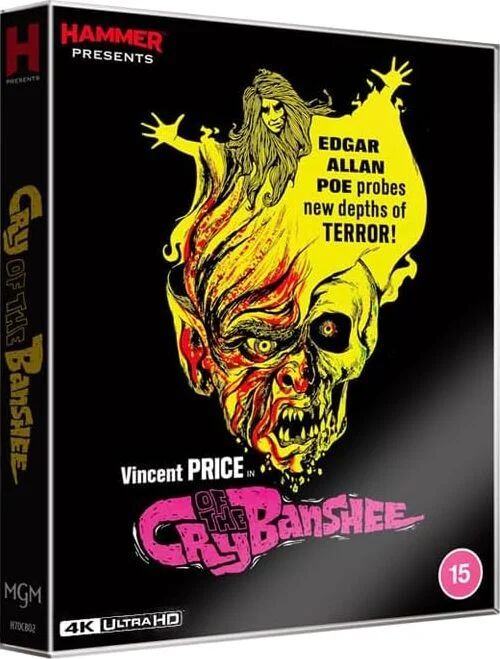
Cry of the Banshee 4K 1970 Ultra HD 2160p
 Like
Like Don't Like
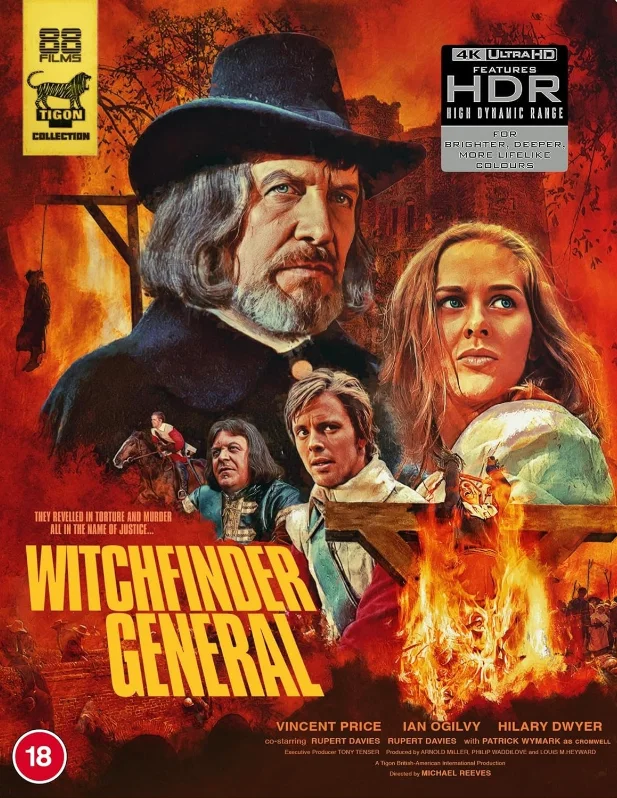
In Elizabethan England, a wicked lord massacres nearly all the members of a coven of witches, earning the enmity of their leader, Oona. Oona calls up a magical servant, a "banshee", to destroy the lord's family. (The "banshee" of this tale bears no resemblance to the normal usage of the term!)
User Review
Medieval England. The Church and the Inquisition zealously expose and punish witches, sorceresses, and other servants of Satan. Nobles of all ranks eagerly join in this thrilling pursuit, turning torture and executions into a form of entertainment. Lord Whitman and his sons, knowing no bounds in cruelty and tyranny, indulge their basest instincts. The locals hate and fear them, for anyone who falls into their hands may be beaten, tortured, and killed. No one will stand up for anyone—for fear of becoming the next victim of the noble family’s terrifying and bloody games. Any girl in the village can fall prey to the lust of either of the lord’s two insolent and brutal sons. After once staging a massacre among the pagans, they spare Una, their elder witch, in order to humiliate her by forcing her to mourn the dead. Una curses the Whitmans and summons the banshees to destroy their entire lineage. The Whitman family begins to perish one by one.
In his film *Cry of the Banshee*, director Gordon Hessler focuses not on the terrifying and bloodthirsty banshee-werewolf—which is barely shown, appearing mainly as a shaggy silhouette emerging from the darkness with clawed, shaggy paws reaching for the victims’ throats— but on the historical and religious plotline. The gloomy Middle Ages—malicious, ignorant, cruel, and terrifying—plunge the viewer into that era immediately, from the very first frames. Anyone the lord points his finger at is immediately declared a witch or sorcerer, condemned to death at the stake, while the unfortunate man’s family members become playthings for the Whitman sons—to be broken and discarded when they grow tired of them. A peasant’s life is worth nothing, and his death is merely a way to have fun at a feast or on a hunt. The complete powerlessness and vulnerability of the subjects in the face of the lords’ cruel perversity in their vile amusements, the hopelessness and fear—that is what is far more terrifying in this film. And this entire eerie atmosphere of complete impunity for the titled and mindless monsters is conveyed on screen with intense focus. The film seems to continue the theme of “The Grand Inquisitor,” especially since Vincent Price played a very similar character there.
The character of Edward Whitman, created by Price, is vivid, as if he had stepped out of the 17th century and split into his clones in *The Red Mask of Death*, *The Grand Inquisitor*, and other similar roles that the famous actor played in abundance. And everywhere, his characters turned out to be vivid, memorable, and sharp-tempered. Price always managed to infuse his characters in period Gothic horror films with life, energy, and a tempestuous temperament, which made the plot a piece of history brought to life, rather than a conventional theatrical production with extras. And the role of Lord Whitman is a true gem in the long line of magnificent characters played by Vincent Price throughout his long acting career. The other actors “hold their own” and look quite good as part of the ensemble, contributing to the final result.
Although the script’s main focus is on the historical framework, elements of mysticism and mystery are lightly woven into the plot. The character of the stablehand Roderick gradually comes to the forefront, embodying the essential traits of Gothic horror. He is a foundling of unknown origin who grew up in Lord Whitman’s household. No one, including himself, knows who he is, who his parents are, or how he came to be in the forest where Lady Patricia, Edward’s wife, found him. Nor does anyone know where he got the strange medallion shaped like the head of a mystical beast, so similar to the wall relief of a deity in the pagans’ cave. He is in love with Edward’s daughter, Maureen; they are lovers hiding their relationship from the lord. But the sorceress’s call makes him an obedient slave to her vengeance, no longer in control of either his feelings or his desires. And even Una’s death, with her desperate plea not to seek revenge on anyone—for revenge destroys the soul, bringing neither satisfaction nor love—is powerless to stop the curse that has been set in motion and its executor.
Despite the fact that the film is titled “Cry of the Banshee,” there is almost no actual wailing in the movie. At the beginning of the film, after yet another of the lord’s excesses with his sons, a dog howls eerily off-screen several times, and everyone speaks in fear, saying that it is the banshee weeping, foretelling the death of the castle’s masters. Edward Whitman merely laughed at the foolish peasants. He had never feared any banshees, did not believe in them, and the severed head of the dog he had killed, displayed at yet another feast, served as proof and a symbol of his might and power. But his boundless malice, cruelty, and pride summoned a very different beast from oblivion—the banshee. It was impossible to kill it, because it is not human and does not submit to his strength, his power, or his whip. It is impossible to flee from the banshee, to hide, or to take shelter.
“He who is born of fire can only perish by fire.” So it was written on the wall of the pagans’ cave and on Roderick’s amulet. Neither a sturdy coffin nor a cross in the graveyard can stop the vengeful spirit. The film’s ending is both unexpected and expected. Beginning as a historical psychological drama about the ruthless Inquisition and the cruelty of the nobility—a theme very popular in cinema at that time—the film gradually shifts into the realm of the mystical, increasingly taking on the traits of a classic Gothic horror. The witch’s family curse tightens the plot into a taut coil of events, deaths, horror, revenge, and mysticism. Evil begets even greater evil, and hatred destroys both the righteous and the guilty. And no one knows where or on whom this vengeful spirit will finally rest. That is why the final scenes became a very powerful, meaningful closing chord.
Info Video
Codec: HEVC / H.265 (74.2 Mb/s)
Resolution: Native 4K (2160p)
Aspect ratio: 1.85:1, 1.66:1, 1.37:1
Original aspect ratio: 1.85:1
Info Audio
#English: DTS-HD Master Audio 5.1
Info Subtitles
English SDH.File size: 49.09 GB