










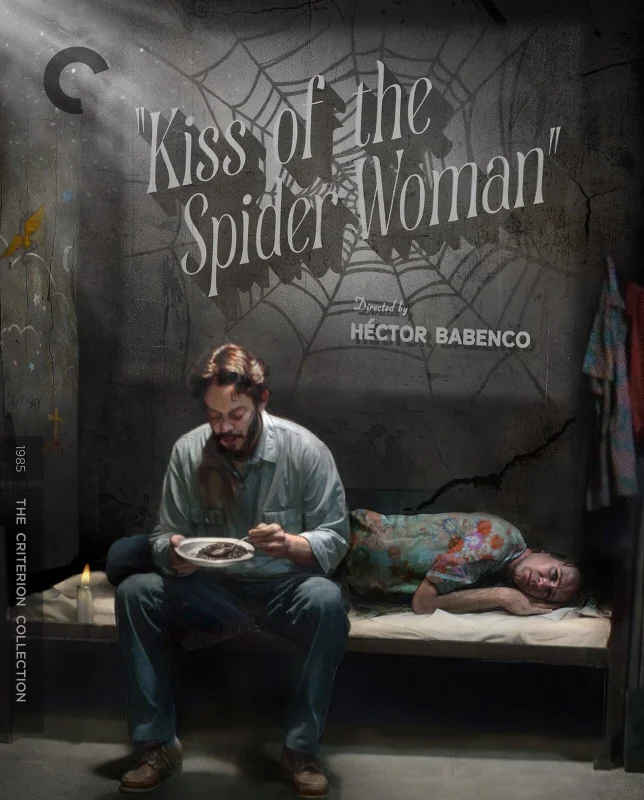
Kiss of the Spider Woman 4K 1985 Ultra HD 2160p
 Like
Like Don't Like
In a South American prison, two inmates become friends: a homosexual serving time for seducing minors and an experienced revolutionary with fresh scars from his last interrogation. While the former tries to escape reality by retelling romantic stories from his favorite movies, the latter thinks about the reasons for the situation. They will have to learn to understand and respect each other.
User Review
In a separate cell of a typical South American prison, two men are serving time—one for political reasons, the other on a whim. Journalist Valentin is often beaten by the regime's loyal lackeys, because being on the far left under a dictatorship is not very acceptable. In turn, Molina, a homosexual, tries to brighten up his miserable imprisonment by putting up colorful posters on the walls and reminiscing about some silly German movie. He is also occasionally summoned to the authorities' office, but instead of beatings, he brings back more and more buns and chicken legs. However, cooperation with the guards does not bring the effeminate gay man much joy, except perhaps that he does not have to eat slop that smells like dog urine. In the space of a prison cell, filled with fear and agony, through conflicting views and coinciding instincts, a strange semblance of friendship develops between the hunted revolutionary and the undercover agent, which, upon closer inspection, turns out to be stronger than some kinds of love.
Kiss of the Spider Woman is not a film about same-sex love. It would be wrong to interpret it as yet another story about how gay people are people too. After all, the novel by Argentine author Manuel Puig, on which Hector Babenco's film is based, woven from the intimate dialogues of two prisoners, conceals in its rather unpretentious plot an unexpected combination of socio-political and moral-ethical ideas. The largely forced communication between the two characters reveals an all too obvious similarity in their dissimilar fates. It lies in their ongoing confrontation: Valentin with a corrupt authority, Molina with an irreconcilable society. And while one wants so much to turn this world into a dream, the other, with no less zeal, tries to fit his own existence into the picture of the world. Fragments of the outcasts' past are mixed with the pretentious plot of a propaganda film, retold by Molina in order to somehow kill time in prison. The cunning director expands the boundaries of his characters' forced abode and breaks the narrative down into separate, unrelated plots, connected only by a common escapist mood. The fifth corner of the stinking cell is not at all the love of one well-groomed man for another sweaty one, and certainly not the hackneyed revolutionary idea of the equality of all mortal beings. In terms of content, the film clearly attempts to prove the existence of free will, albeit from the perspective of compatibilism, according to which a person is free to act on the basis of their own considerations, while their nature is inseparable from universal causality.
Molina, who has become infatuated with the revolution-obsessed Valentin, quite clearly makes rash and risky decisions, but ones that are entirely natural for him.
Where there is virtually no dynamics, the art of presentation comes to the fore. And if Raúl Juliá is simply good in the role of a touching boor, William Hurt turns the film into his own benefit performance in episodes, filling the frame with the image of a man who is only sinful in appearance, but blissful in soul. Hurt's gay character is completely stereotypical, but at the same time not at all comical, and even touching in his smooth, emphatically graceful movements and gestures. And here it is extremely difficult not to slip into banal epithets and enthusiastic pathos. It would have been appropriate to award the actor a double Oscar for best male and female roles - Molina himself considers himself a mistake of nature, and in this image, the feminine principle really prevails. It is no coincidence that the third, invisible character in the film is a woman, played by one actress, Sonia Braga, in three different roles. Only one of them is real, albeit insanely distant—Marta, Valentin's lover; the other two exist in the fictional planes of the films retold by Molina. A caricatured German film, covered with a sepia tone that seems to emphasize the yellowish color of the propaganda plot, and a short story about a spider woman doomed to lure men into her trap. But for Valentin, who has been sentenced in absentia, both of them are Marta - a person who is forever leaving his life and remaining only in the depths of his memory. It is quite possible that the last “woman” close to him will remain a dreamy and devoted homosexual. Paradoxically, the ending of the film, shot in Brazil, corresponds ideologically and figuratively to the ending of another “Brazil,” Gilliam's. But if Gilliam's dream is interrupted by an alarming reality, Babenko finds room for hope even in death, the hope that you will die happy.
Info Video
Codec: HEVC / H.265 (89.7 Mb/s)
Resolution: Native 4K (2160p)
HDR: Dolby Vision, HDR10
Aspect ratio: 1.85:1
Original aspect ratio: 1.85:1
Info Audio
#English: DTS-HD Master Audio 5.1 (48kHz, 24-bit)
#German: DTS-HD Master Audio 5.1
#German: DTS-HD Master Audio 1.0
Info Subtitles
English SDH, Danish, Finnish, French (Metropolitan), German, Italian, Norwegian, Portuguese (European), Spanish (Castilian).File size: 80.07 GB