


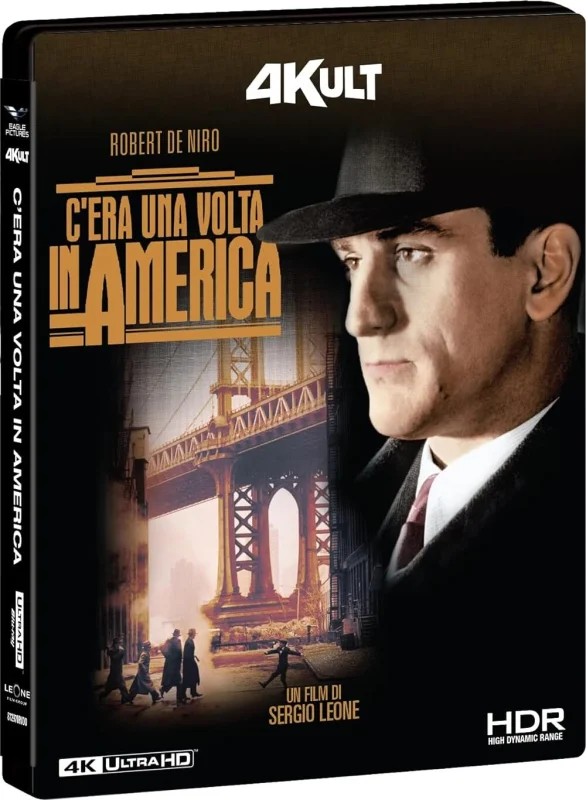
Once Upon a Time in America 4K 1984 Ultra HD 2160p
 Like
Like Don't Like
The life story of several New York gangsters, covering most of their lives—from the early twentieth century to the 1960s. A story about how childhood friends embarked on a path of crime, which inevitably leads to tragedy.
User Review
This is not just a movie, but an entire era. A monumental canvas that some consider a drawn-out bore, while others consider it the greatest gangster film in history. The film is so complex and multi-layered that most viewers, raised on popcorn comics, are simply unable to digest it. Let's take a closer look at this masterpiece, as it deserves. First of all, the main thing to keep in mind is that this is not The Godfather. This is not Goodfellas. It's not a movie about gangsters in the sense that Hollywood has taught us to expect. The gangster saga here is just a backdrop, a setting for a much more frightening and profound story. It's a story about time, about memory, about betrayal, and about how a single mistake, a single wrong choice, can turn your whole life to ashes. It is a requiem for friendship, love, and the “American dream” itself, which turned out to be nothing more than illusions, smoke in an opium den.
Point one: It's not about gangsters, it's about time.
Leone brilliantly breaks the usual narrative structure. The film is not a straight line from A to Z.
It is a mosaic assembled from the fragments of the memory of an old, broken man. Three time periods — childhood in the Jewish ghetto, the turbulent 1920s and 1930s of Prohibition, and the return of the old man Noodles in the 1960s — are mixed together, not for the sake of cheap showmanship.
This is the main artistic technique.
The whole story is the memories of the main character, David “Noodles” Aaronson, who lies in a Chinese opium den and tries to piece together his cursed life. We see everything through his eyes. But can we trust the eyes of a drug addict tormented by guilt?
The entire film is one big question: did it really happen that way? Or is it just the opium-induced delirium of an old man trying to justify his betrayal? Leone doesn't give an answer. He makes you dig into this sordid story yourself, just as Noodles digs into his memory.
Point two: The friendship that never was.
The central theme of the film is friendship. The friendship between Noodles and Max. They have been inseparable since childhood. “Your problems are my problems,” they say to each other. Sounds nice, doesn't it? But all this “friendship until death” is just fairy tales for pioneers.
As soon as serious money and power are at stake, yesterday's “brother” will betray you without hesitation.
Noodles and Max are not friends. They are two opposites who were drawn to each other, only to end up destroying everything around them.
Noodles (Robert De Niro) is the soul of the gang. He is a man of instincts and emotions. He is capable of cruelty, he is a rapist and a murderer, but he still has some remnants of humanity left in him. He wants simple things: money, women, a quiet life. At some point, he realizes that they have gone too far and wants to stop. He is a tragic figure, a weak man who could neither become a real bastard nor remain a human being.
Max (James Woods) is the brains. And this brain is absolutely psychopathic. He is the embodiment of pure, unclouded ambition.
Money is not enough for him. He wants power, he wants influence. His famous phrase, “I don't like the street. I like the door that leads from the street,” is his credo. He doesn't want to be a gangster, he wants to be a politician, a boss who pulls the strings.
He is a serpent tempter who constantly pushes Noodles into increasingly terrible deeds. He is the real devil of this story. Their “friendship” is a constant struggle. Max provokes, Noodles follows. And the apotheosis of all this is the final betrayal. What we are shown is betrayal — absolute betrayal. No one survives that.
Point three: Gallery of broken destinies.
The other characters are not just background. They are victims, crushed by the millstones of Max's ambition and Noodles' weakness.
Deborah (Elizabeth McGovern). Noodles' dream. A princess girl from the ghetto who wants to be an actress. She is a symbol of purity, an unattainable ideal. But she, too, turns out to be just a part of this rotten world. She chooses not the love of a gangster, but a career through the bed of a Hollywood producer. And in the end, she becomes a kept woman. Her final meeting with Noodles is one of the most brutal scenes in cinema. An old, tired woman who has nothing left but makeup and memories. She did not betray Noodles. She simply chose another form of prostitution — a more respectable one.
Patsy and Cockeye. The other members of the gang. Just cannon fodder. Tools in Max's hands, which he throws away without regret when they are no longer needed.
Point four: About the craft.
You can talk endlessly about how it was filmed. Leone is a genius. Every frame is a painting. Slow, lingering shots that immerse you in the atmosphere. Brilliant use of color — the bright, rich colors of the past and the faded, dull tones of the present. And, of course, the music. Ennio Morricone's music is not just background noise.
It is the soul of the film. That piercing, aching flute melody is the voice of time itself, the voice of lost hopes, the voice of unshed tears. Without this music, the film would be half as powerful.
This is not a film you watch. It is a film you live in. For four hours, you immerse yourself in this world and emerge from it a completely different person.
Conclusion
Once Upon a Time in America is not an entertaining film. It is a heavy, painful, depressing spectacle. It does not provide answers; it leaves you with a heavy burden on your soul. But that is precisely what makes it so great. It is a film about how the past cannot be changed. That you have to pay for every mistake. And that the most terrible prison is not the one with bars, but the one you build yourself in your head out of guilt and regret. It is an absolute masterpiece. A film for all times.
Info Video
Codec: HEVC / H.265 (48.2 Mb/s)
Resolution: Native 4K (2160p)
HDR: Dolby Vision, HDR10
Aspect ratio: 1.85:1
Original aspect ratio: 1.85:1
Extended Version:
Codec: HEVC / H.265 (42.3 Mb/s)
Resolution: Native 4K (2160p)
HDR: Dolby Vision, HDR10
Aspect ratio: 1.85:1
Original aspect ratio: 1.85:1
Info Audio
#English: FLAC 1.0
#English: DTS-HD Master Audio 5.1
#English: Dolby Digital 2.0 (Commentary by film critic and historian Richard Schickel)
Extended Version:
#English: DTS-HD Master Audio 5.1 (48kHz, 16-bit)
#French: Dolby Digital 5.1
#German: Dolby Digital 5.1
#Italian: Dolby Digital 5.1
#Spanish (Latino): Dolby Digital 5.1
#Spanish: Dolby Digital 2.0
#Japanese: Dolby Digital 5.1
Info Subtitles
English SDH, Arabic, Bulgarian, Chinese (Simplified), Chinese (Traditional), Cantonese (Traditional), Croatian, Czech, Danish, Dutch, Estonian, Finnish, French, German SDH, Greek, Hebrew, Hungarian, Indonesian, Italian SDH, Japanese, Korean, Latvian, Lithuanian, Malay, Norwegian, Polish, Portuguese (Brazilian), Portuguese (European), Romanian, Russian, Slovenian, Spanish (Latin American), Spanish (Castilian), Swedish, Thai, Turkish, Ukrainian.File size: 86.66 GB