



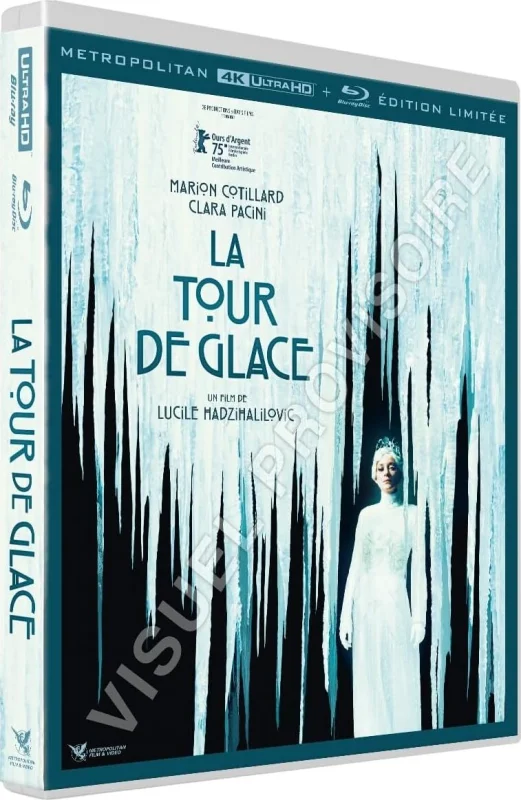
The Ice Tower 4K 2025 Ultra HD 2160p
 Like
Like Don't Like
Fifteen-year-old orphan Zhanna goes from a children’s home to the set of the film *The Snow Queen*. Gradually, the commanding and enigmatic actress Kristina captures the girl’s imagination.
User Review
French director Lucile Hadzihalilovic’s new film is less a screen adaptation of a specific story and more of a meta-fairy tale—a film about cinema at the intersection of reality and fantasy. We’d like to give a big shout-out here to *Mulholland Drive*, *Black Swan*, *Persona*, *Zils-Maria*, and *Holiday in October*. These are just the ones that immediately came to mind—I’m sure there are dozens of films with a similar vibe.
At first glance, the plot is simple: 16-year-old Jeanne runs away from a shelter in the snow-covered Alps and accidentally finds refuge on the set of a film adaptation of “The Snow Queen.”
But beneath the surface lies a completely different story—about how cruelty and power seep into a fragile soul like a dangerous poison.
Like many of Hadzihalilovic’s heroines, Jeanne lives on the cusp between childhood and adulthood. Once she enters the magical world of cinema, she is drawn to the one who seems to her to be the embodiment of the ideal—the cold and dazzlingly beautiful diva Christine, played by Marion Cotillard.
This actress is not merely the Snow Queen in the story—she is an archetype, a mirror, and a temptation for which Jeanne is ready to lose herself.
It is important that Christine here is neither absolute evil nor a caricatured tyrant. Her power is quiet but firm. It arises from distance, understatement, and the ability to be an object of projection.
The more Jeanne becomes entangled in Christine’s orbit, the more pronounced the imbalance becomes: one’s dependence grows, while the other’s empathy fades. Christine does not so much subjugate the girl she has enchanted as she allows herself to be deified. And in this, too, lies a form of cruelty.
Gradually, what unfolds on screen becomes increasingly hallucinogenic. The film set seems to expand to the snowy peaks of the Alps; the artificial light—to sun glare on ice; the dream of belonging to something or someone—to the scale of a dangerous dependence on another’s image.
The central theme here is by no means the struggle between good and evil, but the hierarchy of power and submission. Jeanne and Christina are not merely heroines: they are student and mentor, admirer and object of worship, mirror and reflection. Jeanne gradually becomes a prisoner of the illusion she herself created, and this painfully mirrors how a person seeks themselves through another’s mask, losing touch with their own shadow.
In the finale, the film remains as multifaceted and fragile as the crystal Jeanne stole from Christina’s costume. It glitters in the sun, reflecting hundreds of possible interpretations, and offers no answers. It only multiplies the questions.
What are you willing to do to feel needed?
Where is the line between admiration and idealization? Does the one in power notice how easily they destroy another—or do they no longer care?
In summary: “The Ice Tower” is not a film for everyone. It is a cold, mesmerizingly beautiful mirage of a film, a labyrinth of a film.
But inside, it seems just as colorless as the artificial ice cubes that generously cover its sets, and unless you bring your own meanings and associations to it, Hajihalilovich’s film is unlikely to offer them to you.
Info Video
Codec: HEVC / H.265 (92.9 Mb/s)
Resolution: Native 4K (2160p)
Aspect ratio: 2.35:1
Original aspect ratio: 2.39:1
Info Audio
#French: DTS-HD Master Audio 5.1
#French: DTS 2.0 (Commentary by director Lucile Hadzihalilovic, production designer Julia Irribarria, director of photography Jonathan Ricquebourg and chief sound editor Ken Yasumoto)
Info Subtitles
English, Catalan, French SDH, Spanish (Castilian), Portuguese (European).File size: 78.82 GB