
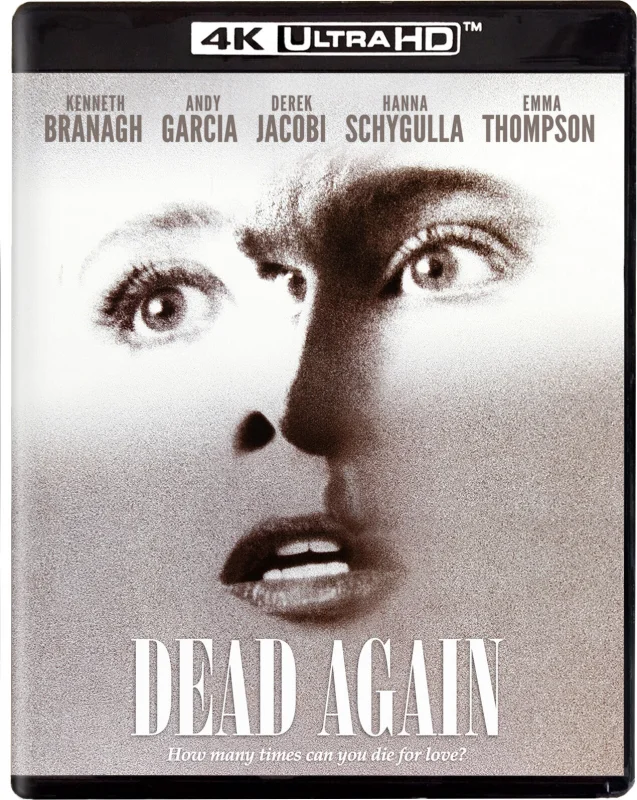
Dead Again 4K 1991 Ultra HD 2160p
 Like
Like Don't Like
Mike Church is a private investigator from Los Angeles who specializes in locating missing persons. He is working on the case of a young woman he calls Grace. She suffers from amnesia and remembers nothing of her past. She is constantly tormented by nightmares in which Margaret Strauss, a pianist from the late 1940s, is killed with scissors by her husband, Roman Strauss. During the investigation, Church turns to Franklin Madson, an antique dealer, for help. With the aid of hypnosis, they hope to uncover the truth.
User Review
My introduction to the brilliant British director and actor Kenneth Branagh began, oddly enough, with Woody Allen’s film *Celebrity*. Then I discovered another American film by Branagh—the mind-blowing *Frankenstein*—after which I added Branagh to my list of must-watch filmmakers. The spectacular film adaptation of Shakespeare’s *Henry V* only reinforced this opinion. The thriller *Die Again*, with which Branagh began his conquest of America, definitively cemented his position on my list of the most beloved and respected figures in cinema.
For his “conquest of America”—which, I’ll say right away, was a success, as evidenced by very respectable box office receipts and an extremely positive critical reception—Branagh chose a mystical theme that deeply interested him.
‘To Die Again’ is, above all, a film about love. About the kind of love that death cannot destroy. It can only suspend it, consign it to temporary oblivion, confine it within the bounds of superstitions and erroneous court rulings or human thoughts, but it cannot kill it—love does not die with a person. And, having found a loophole from the clutches of death, love is ready to be reborn again—perhaps in other people, at another time, but it will be the very same love. Or is it in other people? We have a whole bunch of religions—choose any one you like. If you want, believe that after death you will meet your beloved in the gardens of paradise. Or maybe, after death, you’ll find yourself back on Earth in a different body—male or female—and you’ll search for your other half again, unaware that you were once happy with that beautiful stranger you’re now too shy to approach. And that you had children, and that you’ve already lived one or even two happy lives, and will live a third just as happily? Or, on the contrary, something prevented you from living your first, past life, and someone—it doesn’t matter who—Christ, Buddha, Allah—is giving you another chance. The main thing is not to miss it, to remember everything that happened before, not to walk right past it. And the reward will be great. Love, like the soul, is eternal, but it is entirely up to the person how they will use the only eternal thing they possess.
Reincarnation. Not a new topic. But Brana, as always, with impeccable taste, scatters mystical coincidences and patterns, compelling us to believe both in the reality of the past existence of a certain composer, Roman Strauss, executed for the alleged murder of his wife, and in the reality of what followed, 40 years later—even the reality of reincarnation itself. Not only can we relive the same events from our past lives, we can remember them; we can draw on the experiences of past generations whose fates have intertwined with ours; and perhaps we can even exactly replicate someone else’s fate, or even correct the mistakes that proved fatal in the lives of our twin predecessors.
All of these are highly controversial ideas, but after watching the film, they come across as axiomatic, indisputable. By skillfully blending the past and present lives of characters who are as alike as two peas in a pod, and placing them in circumstances where the heroes of the past became entangled but the heroes of the present must not, Bran draws us into the vortex of a terrifying, mesmerizing, dangerous love story that caused much suffering yet remained pure, unblemished, stirring, and immortal love.
Brana does not set out to scare the viewer; he tells the story in a calm voice, yet a tremor can be heard in it—he is tense, like a taut string, and you can literally feel the excitement with which Brana, the director, views the characters’ story, how he worries about their future and past. Only toward the end does his voice break into a near-scream, ending in literally hysterical tears.
Brana’s greatest achievement is the blending of flashbacks—that is, past reality—with present reality. This blending, which leaves a constant sense of mystery, makes the film a textbook thriller in the best Hitchcockian tradition. We only truly learn what really happened at the very end, since the scattered flashbacks and rambling explanations of the frightened characters explain little, only serving to intrigue us further.
Branagh is a magnificent director and very English. He made a mistake only once, in the very finale, pulling off a rather silly Hollywood trick with the main villain, and this slightly dampens the intensity and tension built up frame by frame throughout the film. Branagh has outdone himself here. He plays two roles, both very interesting—a composer madly in love with his wife and a private detective in love with a girl he knew very well in a past life.
Emma Thompson is magnificent as the woman haunted by memories of the past in her nightmares, terrified out of her wits, every step she takes a step into quicksand. Her fear, emotions, and feelings are so authentic and natural that I never once felt like I was watching the actress Emma Thompson on screen. I saw only her characters. Magnificent roles, full of femininity, the poetry of human tact, delicacy, purity, and love. Probably everything that American actresses sometimes lack so much and that this charming Englishwoman has in abundance.
Robin Williams played a supporting but very important role as a psychiatrist who was barred from medical practice because, in addition to treating some of his patients, he also put them on the couch—under hypnosis, no less. His character serves as a sort of link between the past and the future. Down-and-out, pitiful, and lonely in the present, successful and not particularly ethical in the past, he symbolizes the split between two lives within a single person.
There is nothing vulgar or superfluous in this magnificent film. No crude attempts to pander to the audience or their emotions, no playing along with the audience. This is the confident, masterful work of an artist who knows his worth, telling the story exactly as he sees fit—slightly unsettling yet delicate, calm yet tense, beautiful yet sincere. A brilliant psychological drama, full of British charm and romanticism, that is definitely worth watching, if only to see for yourself that not all foreigners who make it to Hollywood sell themselves out completely.
And also... for some reason, it seems to me that Kenneth Branagh is the reincarnation of the great Laurence Olivier. Not the man himself, no. But his legacy. Olivier died when Branagh was already a fully established actor, but he made his first masterpiece in 1989, immediately after Olivier’s death, and, oddly enough, it was the film *Henry V*, shot exactly 45 years after Sir Olivier had played the role. And from then on, Olivier’s style and manner of acting became increasingly evident in all of Brana’s work, as if the great master had recognized his young compatriot as his heir and inspired him to create new masterpieces. That is how one can die and be reborn...
Info Video
Codec: HEVC / H.265 (95.5 Mb/s)
Resolution: Native 4K (2160p)
HDR: Dolby Vision, HDR10
Original aspect ratio: 1.85:1
Info Audio
#English: DTS-HD Master Audio 5.1
#English: FLAC 2.0
#French: Dolby Digital 2.0
Info Subtitles
English SDH, Arabic, Bulgarian, Chinese (Cantonese), Chinese (Traditional), Czech, Danish, Dutch, Finnish, French (Parisian), German, Hebrew, Italian, Japanese, Korean, Norwegian, Polish, Portuguese (Brazilian), Portuguese (Iberian), Spanish (Castilian), Spanish (Latin American), Swedish, Thai, Turkish.File size: 75.62 GB