





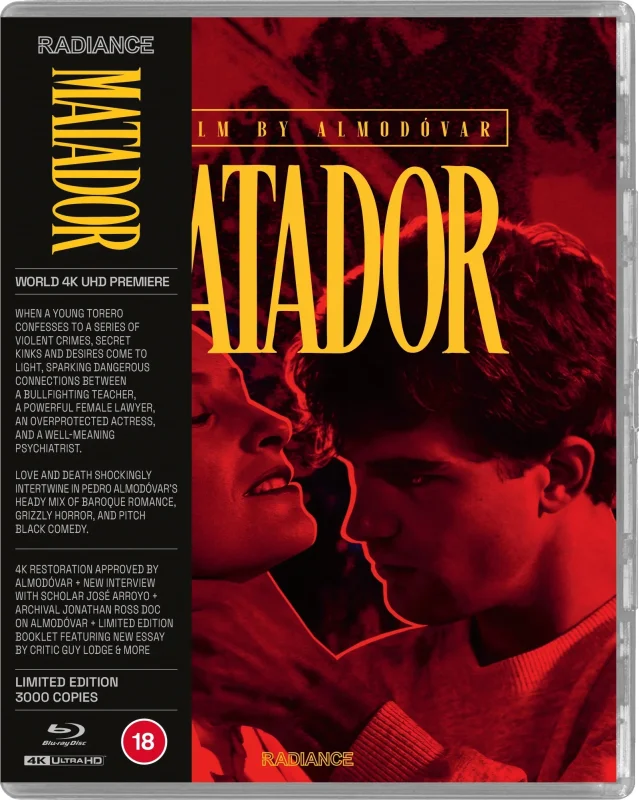
Matador 4K 1986 Ultra HD 2160p
 Like
Like Don't Like
An ex-bullfighter who gets turned on by killing, a lady lawyer with the same fetish, and a young man whose religious upbringing has driven him insane are the main characters in this stylish black comedy about the dark sides of human nature.
User Review
Before animal rights activists began arguing that killing bulls for entertainment is wrong, bullfighting played a major role in Spain’s traditional culture. Almodóvar adds fuel to the fire with his film *Matador*, drawing attention to a slightly different aspect stemming from bullfighting, though he likely did not intend to condemn this dangerous folk pastime, but rather to elevate the abstraction of killing. The plot required an aesthetic maniac, inspired by a bullfight murder and transferring that thrill to human victims. After all, in essence, there isn’t such a great difference between a bull and a human, just as there isn’t a great difference between a duel and wild sex. It is often forgotten that a raging beast is not so much a danger to a man in bright clothes as that very man is to the bull; after all, the Spanish word “matador,” though used nowhere except in bullfighting, has only one meaning: “killer.”
Before *Matador*, Pedro Almodóvar had not made films with such a pronounced criminal slant; there were chases, murders, and transgressions, but never before had they been so tightly woven into a web of intrigue. However, it is clear from the start that the young man from a wealthy, devout family—who dreams of becoming a matador and imitates his teacher in everything—is not the killer who committed several daring crimes. The absurd denouement will entertain the viewer with the director’s artistic flair, and this isn’t even the story of a soft-hearted young man trying to assert himself as someone capable of influencing others’ lives; it’s a romantic tale of the tragedy of people who couldn’t live without murder.
“Matador” is kitsch bordering on art to an even greater extent than Almodóvar’s other early films; he spares no color in bringing his vision to life, making not only the visuals but also the inner essence vivid, where aestheticism blends with the exoticism of forbidden pleasure. The central premise lies in the urge to kill, for if one character can be drawn to death, why couldn’t two or three people be seized by the same passion at once? Of course, the chance of them converging in one place is slim in real life, but cinema exists precisely to bring that cherished moment closer, to create the necessary atmosphere, and to deliver the blow.
Taking a life in this film is a sacred act requiring a prelude; it is almost a ritual sacrifice. Two themes—sexual pleasure and death—are sacred; they are far from naturalism, just like the story’s characters. This is what distinguishes *Matador* from the story of Bonnie and Clyde, which has become a byword for such plots but remains proof of how far the urge to break the law can go in real life. “Matador” is unreal; it is more of a parable or a myth that barely intersects with reality. This is well illustrated by the final scene, when the police surround the killer’s house—despite the proximity of human rights activists and murderers, their fates will never intersect, as if an insurmountable wall exists between the world where the law reigns and the grotesque world of desperate murderers.
Among other things, “Matador” is also a rare “masculine” film for Almodóvar, whose plots have always been dominated by female characters. María Cardenal, a lawyer, is a far more resolute and masculine character than the men around her, who, due to their comical nature, come across as less one-dimensional and even more feminine. Her assertive stance is typical of a male nature, but given that Almodóvar had previously offered almost no significant portrayals of the stronger sex, there is nothing to compare it to. However, strange relationships and gender dynamics have always been present in Almodóvar’s films, and it is not surprising that the men are often feminine, while the first strong character was embodied by the actress Asunción Serna.
Info Video
Codec: HEVC / H.265 (78.2 Mb/s)
Resolution: Native 4K (2160p)
Aspect ratio: 1.85:1
Original aspect ratio: 1.85:1
Info Audio
Info Subtitles
English, Danish, Finnish, French (Parisian), Greek, Italian, Norwegian, Portuguese (Iberian), Swedish.File size: 58.88 GB